Scientists learn that fish suffer around 10 minutes of “intense pain” when killed during the catch process by air asphyxiation.
A new study published in Scientific Reports and featured in an article from Earth.com spotlights the suffering of fishes when they are caught and killed for food.
While land animals killed for food in Canada must be stunned before slaughter, there is no such law around fishes. Wild-caught fishes are commonly killed by asphyxiation (slowly suffocating to death in the open air), which leads to immense fear and suffering.
The research found that “the average trout endures about ten minutes of pain that qualifies as hurtful, disabling, or excruciating. In some conditions, this could stretch beyond 20 minutes.”
Researchers evaluated stunning as an alternative to prolonged asphyxiation for fish. Their findings highlight flaws in both the stunning methods they evaluated.
“Electrical stunning, if properly used, could spare 60 to 1,200 minutes of suffering for every dollar spent … But implementation remains inconsistent. In many commercial settings, electrical stunning fails to reliably render fish unconscious.”
“Percussive stunning – a physical blow to the head – has shown better consistency in lab settings. But it’s difficult to scale.”
As we recognize that fishes are sentient animals who feel pain, experience fear, and try to avoid suffering, there is one method that can consistently protect their well-being: switching from fish to plant-based alternatives on our plates.
The draft plan looks at adaption strategies to build resilience into the city’s infrastructure against major climate impacts. Food should be part of that conversation.
By adding plant-based food strategies into their draft plan, New Westminster can take a practical step toward strengthening food resilience by increasing access and affordability and reducing pressure on high-impact food systems.
TAKE ACTION: If you live or operate a business in New Westminster, please take a few minutes to comment on the City’s Draft Plan, encouraging them to consider plant-based foods as part of their strategy.
New West can build climate resilience through plant-based food.
When people think about preparing a city for climate change, they often picture cooling centres, shaded streets, stronger buildings, flood planning, and emergency response. But resilience is also about everyday needs, including whether people can access affordable, nutritious food when climate impacts disrupt daily life.
New Westminster can help build climate-ready neighbourhoods by supporting increased access to affordable plant-based meals, shelf-stable plant-based proteins, locally sourced produce, and culturally appropriate food options.
Below are key sections of the draft plan where New West residents and businesses can ask the City to include plant-based food.
If you do not have time to comment on each section, you can adapt the comment below and email mayorandcouncillors@newwestcity.ca:
“Please include plant-based food in New Westminster’s climate adaptation and resilience planning.
Plant-based foods can be part of a stronger and more resilient food system. Foods such as legumes, grains, seeds, nuts, fruits, vegetables, and plant-based proteins can be affordable, nutritious, lower-impact, and easier to store than many animal-based products.
Climate impacts can disrupt food access and increase costs, so the City should support affordable, nutritious, lower-impact options through public facilities, City-run programs, community events, emergency planning, food security initiatives, and partnerships with local businesses and community organizations.
Plant-based food policy is a practical climate solution.
Animal products use a large share of the world’s farmland and contribute more than half of food-related emissions, while providing a much smaller share of global calories and protein.
C40’s Good Food Cities work found that cities shifting public food procurement saw a 31% drop in high-emission foods, a 44% increase in plant-based foods, and a 16% drop in food-related greenhouse gas emissions from public food purchasing.
And a Vancouver Humane Society cost-benefit analysis found that replacing 20% of the City of Vancouver’s animal-based food purchasing with plant-based alternatives could save up to $99,000 and reduce emissions by more than 500 tonnes.
Plant-Based Cities Movement notes that 82% of Canadians live in cities and that most food is consumed there. That gives municipal governments a real opportunity to reduce food-related emissions through local policy.
For New Westminster, including plant-based food in their strategies offers a practical way to strengthen climate resilience while also reducing emissions, saving public funds, and helping prevent animal suffering through everyday policy choices.
Take quick action: Share this graphic
Help more New West residents learn about this opportunity.
Share this graphic on your social media before the May 31 deadline and encourage others to comment on the draft plan.
Key sections for comment:
To comment, create an account on New West’s online platform ‘Be Heard’, review the draft plan, and add your feedback directly to the sections you care about. You can leave as many comments as you’d like throughout the draft plan.
To make your submission impactful, and to ensure that it is included, do not copy and paste the text below. Use your own words so your submission reflects your personal concerns and experience.
Action 2.2.3: Public facilities can lead by example
Public facilities are more than just buildings. They are places where people gather, learn, celebrate, receive services, exercise, and build community.
As New Westminster updates public facility policies, the City could include food service and procurement in that work. This could mean making plant-based options available at City-hosted events, meetings, recreation centres, community programs, seniors’ programs, and other public spaces.
A climate-resilient public facility should not only be energy-efficient. It should also support access to affordable, nutritious, lower-impact plant-based food options in the places residents already use.
Theme 3: Neighbourhood resilience includes food access
When a heat wave, flood, storm, or supply chain disruption occurs, food access becomes a public resilience issue.
That is why plant-based food should be considered in emergency planning, food security work, community kitchens, public programs, and local food partnerships.
New Westminster can help build climate-ready neighbourhoods by working with community partners to improve access to affordable plant-based meals, shelf-stable plant-based proteins, local produce, and culturally appropriate food options.
Theme 6: Everyday City decisions can build food resilience
The draft Climate Plan says climate risk and resilience should be integrated into day-to-day decision-making and City operations.
New Westminster could make plant-based options a normal part of City operations by:
Requiring plant-based options at City-hosted events and meetings
Adding plant-based considerations to procurement guidelines
Providing staff guidance for plant-forward catering
Supporting public education about climate-resilient food choices
Ensuring City-supported food programs include affordable plant-based options
City decisions about catering, events, grants, facility rentals, community programs, concessions, procurement, and public education all shape what food options are available.
Action 6.1.8: Funding local food resilience solutions
Small grants, pilot projects, public education, and partnerships could help residents access affordable, nutritious, lower-impact plant-based foods while supporting broader climate resilience goals.
For example, the City could support plant-based cooking workshops, community kitchen programs, food security partnerships, local growers, community gardens, food forests, or pilot projects in recreation centres and community centres.
These kinds of initiatives can reduce barriers and help residents see that resilient plant-based food can be familiar, affordable, culturally relevant, and enjoyable.
New West residents: Take action by May 31!
Food is key part of climate resilience. New Westminster has an opportunity to make affordable, climate-resilient, animal-friendly options more available in the places people already gather.
If you live or operate a business in New Westminster, please take a few minutes to ask the City to include plant-based food access in the plan.
Take action: Ask decision-makers to stop using public funds to support rodeo events and to strengthen protections for animals used in entertainment.
Image credit: Jo-Anne McArthur / We Animals
A horse and rider are recovering after a saddle bronc incident at this past weekend’s Cloverdale Rodeo, renewing concerns about high-risk and high-stress rodeo events that put both people and animals in danger.
According to the Surrey Now-Leader, the incident took place on Saturday night during the 2026 Cloverdale Rodeo. Rider Nick Patterson and the horse Spring Season became tangled during a saddle bronc bucking event and went down together. Patterson was transported by ambulance for further evaluation and later released, while Spring Season is reportedly recovering.
The reported recovery of both Spring Season and Patterson is welcome news. Still, the incident raises broader safety and animal welfare concerns.
Rodeo poses a risk to both human participants and animals, but unlike humans, the animals did not choose to be there.
For example, in saddle bronc riding and other bucking events, animals are confined in chutes and released into an arena for an event built around provoking or maintaining a bucking response. Equipment and practices such as flank straps and spurring add pressure to the animal’s experience.
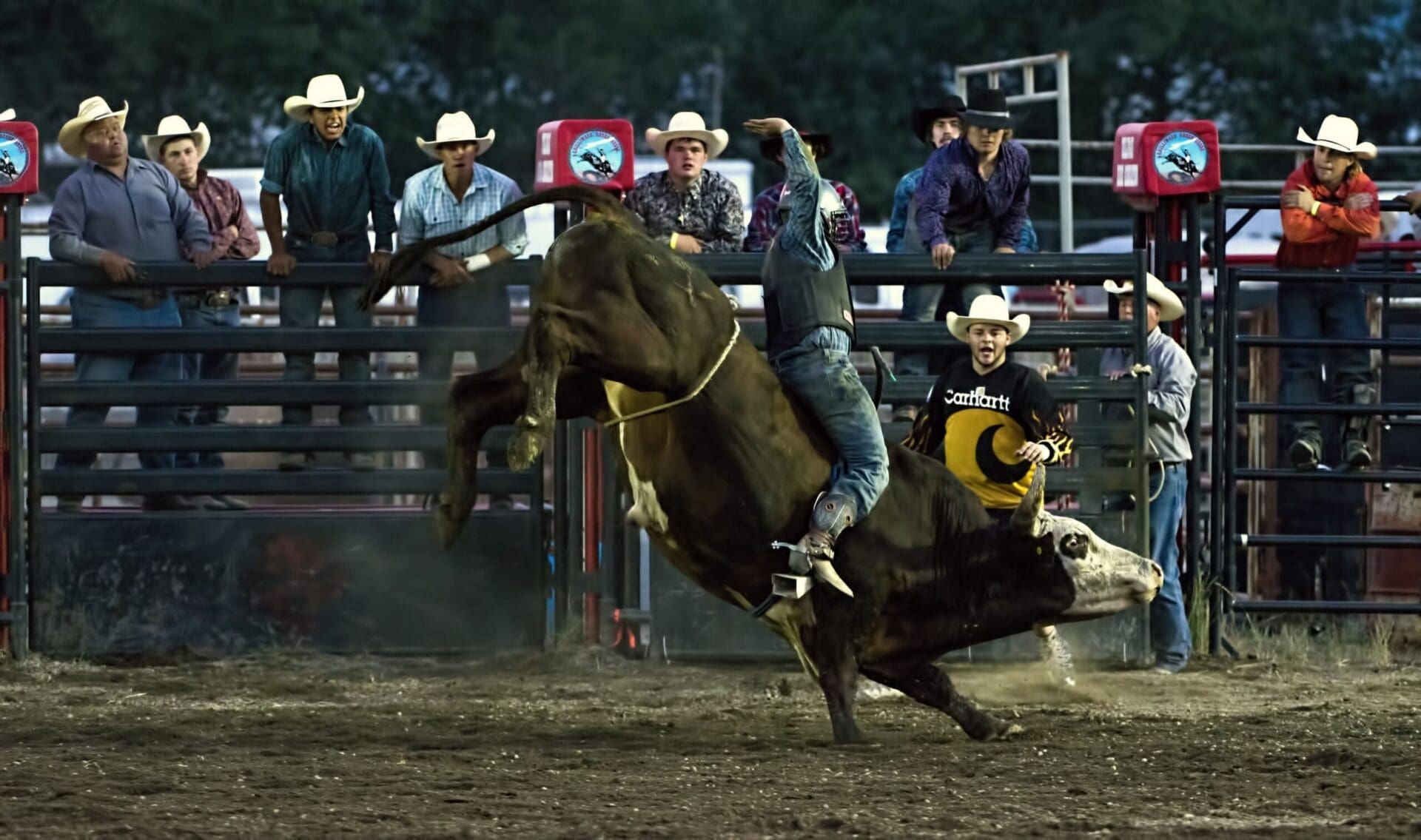
Image: bull riding/bucking event at Chilliwack rodeo
Animal welfare is about more than whether an animal survives or avoids visible injury.
It includes their physical health, emotional state, ability to express natural behaviours, freedom from fear, pain, and distress, and ability to have some control over what happens to them.
Incidents like this also point to the need for stronger public policy, including ending public funding for rodeo events and strengthening regulations to better protect animals.
That is why the VHS continues to call for an end to rodeo events that cause animal suffering, stress, injury, and death.
Communities can come together, celebrate tradition, and enjoy local events without putting animals through fear and stress for public entertainment.
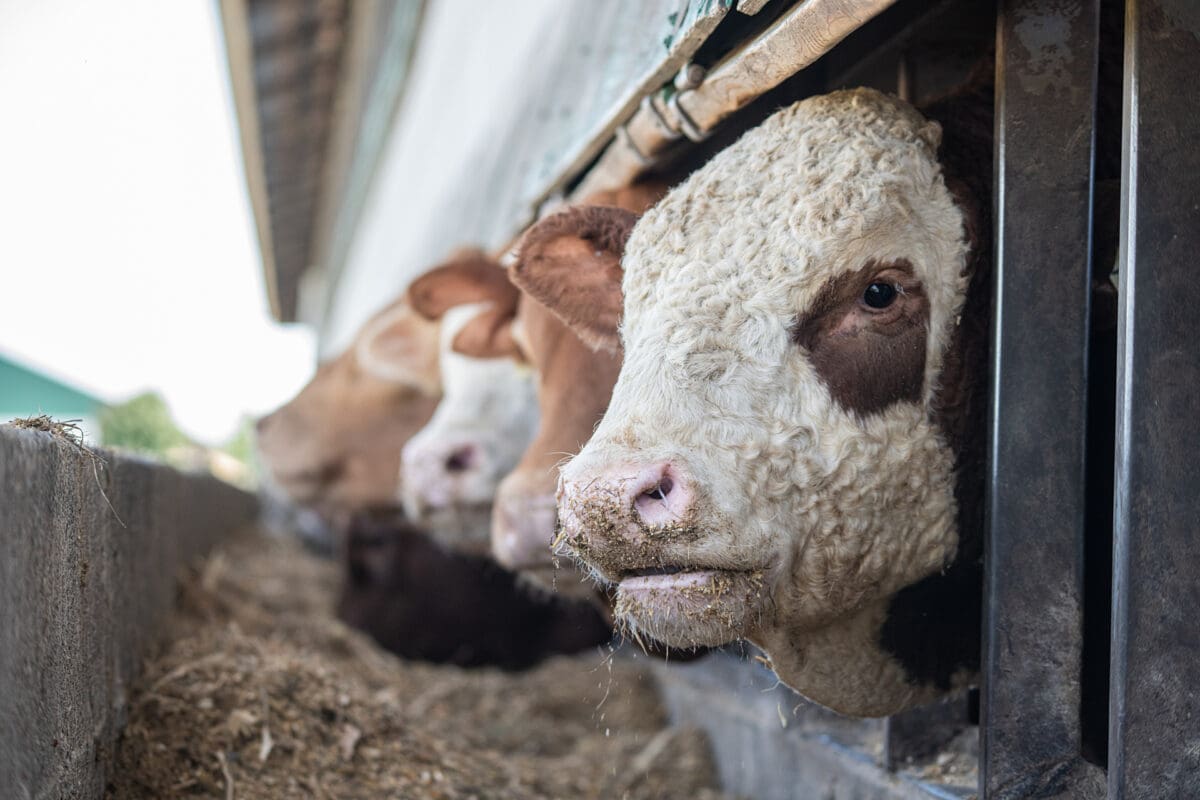
Cows looking at the camera, this breed Shorthorn or Durham, typical of Argentina.
The National Farm Animal Care Council’s (NFACC) Beef Code of Practice outlines guidelines for the on-farm care and handling of cattle raised for beef in Canada.
The code is being updated for the first time since 2013 and a public comment period is open until June 12, 2026.
While there are a few improvements, the new draft code fails to address some of the most significant welfare issues within the beef cattle industry.
Join the VHS in calling for stronger requirements for shelter, daily monitoring, pain control, humane handling, transport decisions, and emergency planning.
TAKE ACTION: Share feedback on the draft code on the issues that are important to you; everyone can participate!
However, we have prepared the VHS’s top welfare priorities with section headers and tips for submitting your feedback, if you are short on time and would like guidance.
Short on time? Under the heading ‘Which section of the draft Code would you now like to provide feedback on?’, select ‘General Comments on the Code’. This will allow you to bypass providing feedback on each section of the code.
IMPORTANT: Do not copy and paste wording, as duplicate responses and/or profanity or derogatory language will not be considered by NFACC.
Section 1: Animal Environment
Section 1.2: Facilities for all cattle
Comment on Requirements:
Currently, there is no minimum shelter requirement to protect cattle from heat, cold, wind, rain, or other harsh weather.
The Code should set clear minimum shelter space requirements based on herd size, as well as maximum stocking densities (e.g. number of animals/acre) for cattle on pasture, feedlots, and auction markets.
The Code should require enrichment opportunities that allow cattle to express natural behaviours, including foraging, exercise, social behaviour, and grooming.
The Code should also prohibit tethering cattle as a form of housing. Tethering (tying an animal to an anchor point) should only be used temporarily when necessary for handling or procedures, and it should never be used as a regular housing practice.
Section 2: Feed and Water
Section 2.2: Water
Comment on Requirements
Cattle should have reliable access to clean water, including during heat waves and/or periods of high humidity, and water sources should be monitored regularly.
Snow should not be permitted as the sole winter water source. Snow may not reliably meet cattle’s needs, especially if conditions change or cattle are not checked frequently. A backup water system should always be required.
Comment on Recommended Practices
The following should be requirements:
Water sources must be easy for cattle to find and access.
The number of watering points and flow rate must be appropriate for the herd size.
Automated water systems must be checked daily to ensure they are working properly.
Section 3: Animal Health
Section 3.3.1: Disorders of the Respiratory Tract
Comment on Requirements
Recently weaned calves and newly arrived feedlot cattle should be monitored at least twice daily for two weeks to support early detection of respiratory disease.
A risk-based bovine respiratory disease prevention strategy should be a requirement as part of every herd health program, given that it is a significant health and welfare problem in the beef industry.
Section 3.3.2: Lameness
Comment on Recommended Practices
Lameness is a painful leg or hoof condition that is a common welfare issue within the beef industry. The Code should require training on causes, prevention, and treatment of lameness.
It should also require producers minimize cattle exposure to mud and standing water, and to include lameness prevention strategies in herd health programs.
Section 3.4: Safety and Emergencies
Comment on Requirements
The Code should require stronger emergency planning for fires, floods, and extreme weather.
Newly built facilities should have fire suppression and flood mitigation systems. Existing facilities should be retrofitted where possible.
Section 4: Animal Husbandry
Section 4.1: Handling and Moving Cattle
Comment on Requirements
Electric prods are used during handling and provide an electric shock to the animal. These devices cause pain, stress, and can lead to injury.
Given that electric prods can also easily be overused and that humane alternatives exist and are effective, the Code should prohibit electric prod use and require low-stress handling methods.
Section 4.3: Identification
Comment on Requirements
Branding, which is used to permanently identify cattle, should be prohibited.
Branding is painful and unnecessary, especially when alternatives such as microchipping, visual identifiers, descriptive markings, coat patterns, colour variations, and properly fitted leg bands are available.
Section 4.4: Disbudding and Dehorning
Comment on Requirements
The Code should require practices that eliminate painful horn removal (disbudding and dehorning) procedures, such as transitioning to hornless breeds of cattle.
Section 4.5: Castration
Comment on Requirements
Cattle should be castrated as young as practically possible and provided both anesthetics and pain control, in consultation with a veterinarian.
Comment on Recommended Practices
Calves must be monitored after castration to ensure they are nursing or eating and to check for signs of infection or other complications.
Section 4.5.1: Spaying
Comment on Requirements
Spaying should only be carried out by a veterinarian, and both anesthetics and pain control should be required.
Section 4.6: Weaning
Comment on Recommended Practices
Abrupt weaning of calves from their mothers should be prohibited. Low-stress, gradual weaning strategies should be required.
This includes two-stage or fence-line weaning, avoiding weaning during other major stressors such as adverse weather, commingling with animals from other groups, marketing, or transport, and avoiding painful procedures like branding, dehorning, and castration at the time of weaning.
Calves should also be acclimated to human handling and feed delivery methods they will experience after weaning.
Section 4.8: Tail Docking
Comment on Requirements
Tail docking should only be permitted when medically necessary, in consultation with a veterinarian, and with both anesthesia and pain control.
Section 5: Preparations for Transport
Section 5.1: Evaluating and Preparing Cattle for Transport
Comment on Recommended Practices
Transport is a stressful process that can pose a significant risk to the health and welfare of cattle. Therefore, the Code should require stronger protections during transport decision-making, planning, scheduling, and loading/receiving.
Farm personnel should be trained and have ready access to the Canadian Food Inspection Agency’s (CFIA) guidance and veterinarian-developed protocols for assessing an animal’s fitness for transport.
Monitoring should increase as the transport date approaches, so health or body condition concerns can be identified early.
If there is uncertainty about whether an animal is fit for transport, consulting a veterinarian should be required.
Section 5.2: Planning and Scheduling Transport
Comment on Recommended Practices
Transport should be planned to minimize the time animals spend loaded in parked vehicles and to account for forecasted weather conditions. Transport must not take place during extreme weather.
Section 5.3: Loading and Receiving Cattle
Comment on Recommended Practices
The Code should require loading practices that reduce stress and injury, including adjusting loading densities, absorbent material for the weather conditions and providing ramps when the vertical distance between the loading surface and vehicle floor causes cattle to hesitate, stop moving forward, or refuse to move.
Section 6: On-Farm Euthanasia
Section 6.1: Euthanasia Decisions
Comment on Requirements:
Delayed or inappropriate decisions around humane euthanasia can lead to prolonged animal suffering.
The Code should require training to help personnel assess quality of life, prognosis, and when euthanasia is needed. A required training module should be developed to support timely, humane decision-making.
General Comments
The Code should include a clear duty of care section, similar to other Codes of Practice, which require that all personnel responsible for cattle must be required to know the Code, be properly trained, and be competent and confident in cattle care and handling.
The Code should also require cattle to be checked dailyat a minimum. Daily observation is essential to identify illness, injury, lack of access to food or water, extreme weather impacts, calving difficulties, and other welfare concerns.
There should also be stronger requirements for consistent, practical tools for measuring welfare outcomes across the beef cattle industry.
To make your submission impactful, and to ensure that it is reviewed by NFACC, consider these tips before submitting your feedback:
REMINDER: Do not copy and paste the text below, as duplicate submissions will be ignored by NFACC. Use your own words so your submission reflects your personal concerns and experience.
Keep responses relevant to on-farm practices.
Provide references and examples whenever possible.
Reference exact wording in the draft code that you would like to see changed and how you would like it changed.
Make it personal, the committee members are interested in how this code impacts you.
Thank you so much for taking the time to speak up for beef cattle in Canada.
Learn about farmed animal welfare in Canada and what you can do to help! Sign up now to get clear explanations, action alerts, and practical steps you can take when it matters most.Click here to learn more.
In this episode of The Informed Animal Ally podcast, Vancouver Humane Society Communications Director Chantelle Archambault and co-host, VHS Executive Director Amy Morris, are joined by PlantUniversity Coordinator Matthew Wattier. Together, they discuss the importance of plant-based advocacy on post-secondary campuses, PlantUniversity’s role in organizing the recent UBC VegFest, the challenges involved in coordinating a large-scale campus event, and what’s next for the program.
Note: This written discussion has been edited for length.
Chantelle: Hi and welcome back to the Informed Animal Ally from the Vancouver Humane Society. I’m Chantelle Archambault, the Communications Director here at the VHS. As always, I’m joined by my cohost, the VHS’s Executive Director Amy Morris.
Today we’re also joined by a special guest, the VHS’s PlantUniversity Coordinator Matthew Wattier. Matt joined VHS in June 2025 as our plant-based advocacy program, PlantUniversity, pivoted to focus on outreach to post-secondary students. He has a Bachelor’s degree in Business Administration from SFU. He has also worked closely with students and faculty at UBC, first as a coordinator for student-led educational projects for professors, and later as a communications professional for the Faculty of Applied Science.
Matt is passionate about addressing inequities for animals and humans alike, and places a strong focus on effectively campaigning for a transition to a plant-based lifestyle. He is fascinated by the science behind beliefs and persuasion, and hopes to work towards a more equitable society one conversation at a time. Thank you so much for joining us today, Matt.
Matt: Thank you Chantelle, it’s so great to be here!
Chantelle: Can you start by telling us a bit more about your background and what led you to this role as the PlantUniversity Coordinator for the Vancouver Humane Society?
Matt: Well, I’ve been lucky enough to work on some of the great campuses in the Lower Mainland over the years. I went to SFU for my business degree, and then went through their co-op program. The student-led educational projects were at a place called Emerging Media Lab at UBC. They are a sort of experimental space where students and professors use the latest technologies and see how they can apply them to a classroom setting. An example is utilizing AI to assist law school students in practicing for moot court.
My second co-op was with the Faculty of Applied Science at UBC, where we celebrated all the amazing research that the faculty there were working on. I’ve also been plant-based for over five years now, and have always been so fascinated by why people do what they do, and what causes them to change. That curiosity and familiarity with the campus ecosystem is what led me to this role.
Amy: Was there a specific moment or experience that first pushed you toward plant-based advocacy?
Matt: I have to first give credit to my older cousins who were eating plant-based to varying degrees when I was just a kid. When you don’t know anyone who does something unfamiliar, it’s easy to write off that behaviour as odd, but seeing my cousins thrive and advocate for plant-based at that age was a big deal towards normalizing it. I remember having a specific moment where I thought ‘wait- have I even thought about why I am eating meat, or am I just doing what everyone else is?’ That led me down a journey where I learned a lot about factory farming and the unfortunate conditions animals are subjected to for us to eat meat.
Eventually, I concluded that one of the best ways I could help animals was to limit the animal products I consumed, which quickly led to me going fully plant-based. I love a good-faith debate, and I really care that my actions align with my beliefs, so putting that towards advocacy seemed like a natural fit. I’ve helped a lot of my close friends and family see my perspective about why it’s a good idea to eat more plant-based, so expanding that further to folks I don’t know was the natural next step.
A history of plant-based advocacy at VHS
Chantelle: I’m so excited to have you on the team working on this project and also to be speaking about our PlantUniversity program again because our plant-based advocacy work is something I’m really passionate about.
As we’ve spoken about before on this podcast, eating plant-based is probably the best way you can make a personal impact in saving the lives of farmed animals every single day. Just to share a bit more about the program for people who may not be familiar, the VHS has been advocating to make plant-based eating more accessible for more than a decade.
From 2019-2022 we had two separate programs, one called Go Veg encouraging people to eat more plant-based foods and sharing resources to help people choose those animal-free foods more often, and another called Plant-Based Plates that worked on helping institutions like schools and hospitals shift their menus toward more plant-based options, which was an expansion from our work on Meatless Mondays. That work was going on even before Amy and I joined the organization—the Meatless Mondays program work was happening way back in 2015.
In 2022, we combined those two program areas into one large plant-based advocacy program, PlantUniversity. I’ve been working with the program since then and it’s been very exciting work sharing with people and institutions the benefits of transitioning to more plant-based foods and practical tips to actually do that.
All that background brings us to our pivot last year, when we brought our advocacy work into a more specific scope with the post-secondary campus project. This is exciting because everyone from the VHS who has worked on this project is actually on this call right now—I’ve been leading the strategy with Amy’s support, and Matt has been working on the ground to bring this advocacy work into schools day-to-day.
Matt, could you share about what PlantUniversity has been trying to achieve with our post-secondary campus project in the 2025-2026 school year?
Matt: So, with PlantUniversity, we’ve been aiming to connect with university students specifically to showcase why they should care about eating more plant-based. This has involved empowering student leaders on campus to advocate with their peers by sharing why they should consider plant-based, but also focusing a lot on how to break down barriers that students have that are preventing them from choosing plants.
We found through research and anecdotal experience that students tend to know that they should be eating a plant-forward diet, but have many reasons that get in the way of that, such as nutrition anxiety or not knowing what to cook. Finding ways to address these barriers, rather than just explaining the why, has been a big part of the PlantUniversity campaign this year.
Amy: Why are post-secondary students such an important demographic to reach with this kind of advocacy?
Matt: Post-secondary students are a really important demographic for a few reasons. First, they are very interested and engaged with social justice and advocacy, so moving toward plant-based feels like a natural next step as they already want to work towards a better world. These students are our future policymakers, so explaining how important plant-based eating is invests in the future of animal advocacy. Second, for many students, this is the first time in their lives when they are making decisions about what to eat, either by cooking or choosing options at a dining hall. Showing why and how to pick plants at this pivotal moment can shape food choices for a lifetime.
PlantUniversity at UBC VegFest
Amy: The program’s biggest event of the year was the first-ever UBC VegFest; you were a lead organizer who made that happen. Can you tell us about that event and who was involved?
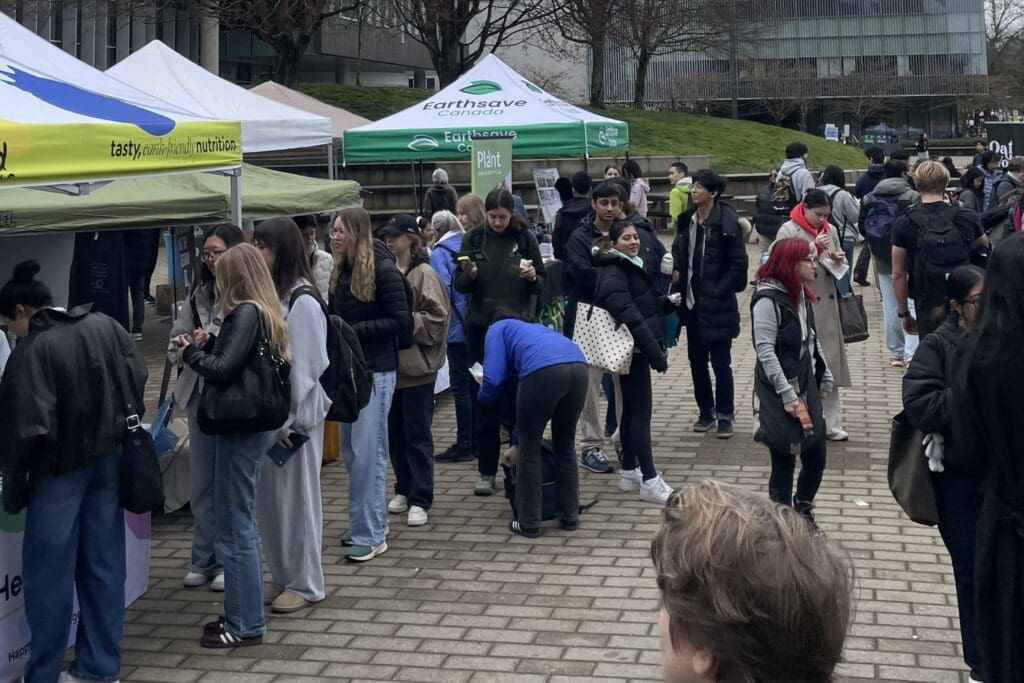
Matt: Yes! UBC VegFest was a really exciting event, which was a joint effort between PlantUniversity, the Vegans of UBC club, and the Alma Mater Society at UBC. It was part of Sustainability Week at UBC, and was an opportunity to showcase all of the amazing local brands working towards climate-friendly food solutions for our future. We also had advocacy groups to help students understand the climate impact of animal agriculture, what they can do, and what groups at UBC are already doing. It was a blast to work with so many local brands and school groups and the reception on campus was really great.
Chantelle: Absolutely, this was a massive event and truly a group effort to bring it together. Matt mentioned the co-hosts, and we also got support from TMRW Foods, Vegan Supply, and Seeds Sustainability Program at UBC in organizing and promoting the event. And then every single one of the 25 local food brands that attended offered free samples for people to try—that included brands you’ve likely heard of like Daiya, Oat Worthy, and Yoggu, and really exciting local favourites like Nora’s, Bonus Bakery, and Sai Plant Deli. Sai was selling plant-based chicken and they had a lineup around the corner for the entire six-hour event.
We’ll probably be having all these vendors back for future events, so if anyone is in the Vancouver and Okanagan areas and didn’t get a chance to go to the first event, you can follow PlantUniversity.ca and Vancouver Humane Society on social media to make sure you hear when the next ones are coming up.
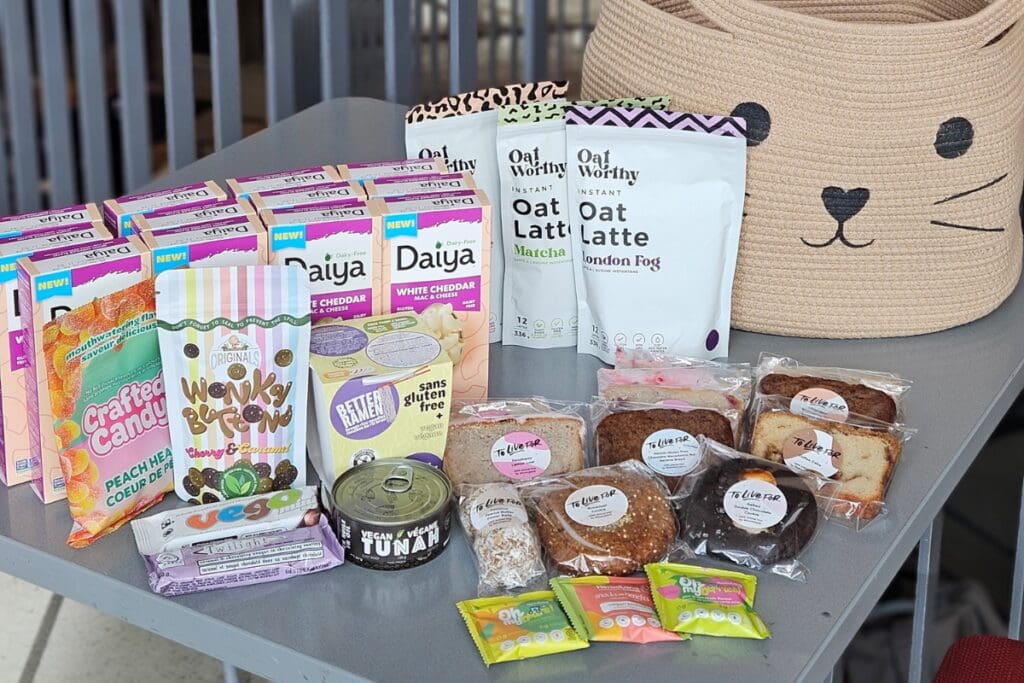
The winner of the UBC VegFest early bird draw showed off her gift basket, with items generously donated by Daiya, Oatworthy, Vegan Supply, To Live For, and Herbaland.
Amy: What kind of reach and response did you see from that event?
Matt: We had over 25 local brands showcase their products through samples and sales, and they gave away over 18,000 samples. We estimate that there were around 5,000 guests at the event, which was more than we could have ever imagined. The vendors were so happy to see the turnout, which is very important to show that an event is worth coming to when you are a small business who has to be considerate to where you put your time and energy. The students and other guests we surveyed also had a high opinion of the event, with almost everyone saying it improved their perception and consideration towards plant-based eating.
Chantelle: We knew it was a successful event based on the huge turnout when folks were there, but those surveys from the vendors and attendees were really exciting to see. Like Matt said, most people said the event changed their views on plant-based eating in a positive way, just 16% were neutral and no one had a negative change. Most people, about 59%, bought something at the event so we know people were interested in taking the food they tried at the event and carrying it into their routines afterwards. And a vast majority said they would recommend the event to a friend, at 96.1%.
We know this was reaching people beyond the vegan community as well so it was a great opportunity to encourage people to change their eating habits and expose them to plant-based foods and compassionate messages in a fun and welcoming way. About two-thirds of the attendees were not vegan. And about three-quarters were students, so the people in our target audience for the program who are in a stage of their lives where they’re forming opinions and habits that will make a difference to what kinds of foods they choose in the future. The rest of the attendees were faculty, staff, and members of the surrounding community.
Amy: For students and other advocates who would like to pull together something similar, what would be the first steps to getting the ball rolling on a VegFest event?
Matt: First, I think you are in a great position if you’re trying to put on an event at your campus! Student groups like your local AMS or Student Society are a great place to start. They often have privileges that make setting up an event easier than an external group. I would check there first and see what the process is for getting an event going. Students tend to love events that offer free food and bring life to campus, so creating a pitch of the event with those things in mind is a good plan. Once you get going there, look into funding opportunities for students. Universities love to promote projects, and often have grant money they’re trying to give to students. Especially if it pertains to sustainability or social justice initiatives, which a VegFest most certainly does!
Chantelle: Absolutely, working with clubs, sustainability programs, and student societies is a great way to go because they have a lot of knowledge about how the school community works. You may be able to work with local advocacy organizations, the way the VHS collaborated with the Vegans of UBC, who can help find different funding paths. And there are often grants available through the school, community organizations, or advocacy organizations for events that reach a lot of people and make a high impact like this.
Our campaign guide delves into all those partnerships, how to start reaching out to local businesses that may be willing to offer free samples to get their name out there, and how to market the event to make sure people actually come. Again, you can find all that in the Campus Advocacy section of PlantUniversity.ca
Amy: What were some of the biggest challenges or things to keep in mind as someone is planning an event like this?
Matt: One thing that is important to understand when working with small businesses is that it’s important that you make the event worth the effort for them. They are doing such amazing work and are often running with fewer resources and people than big companies, so creating a way where they can promote their brands without a ton of extra time or effort on their end will get a lot of real interest. There’s also a bit of a chicken-and-egg scenario where a university might want confirmed vendors first, and vendors might want a confirmed space before committing. Being honest with both parties about this scenario and levelling with them is the best way to get the commitment you need from both sides.
Chantelle: I want to add that I don’t know if this is a challenge, but it’s definitely something you want to keep in mind: You’ll really want to make the event visible.
We were able to hold our VegFest in a very central location on campus where there was a lot of walk-through traffic, and we also had posters up all around campus; SEEDS at UBC helped us get promos for it on all the TV screens promoting upcoming activities around campus, and we had signage up all around the actual event so people knew what was happening. We posted it in all the local Facebook groups for the vegan community and local events and shared it with our email list and on social media. We basically shared it everywhere we could.
You can have an amazing event with the best food and the most impactful advocacy messages, but if people don’t know about it they’re not going to go. So, really making sure you promote the event very heavily and host it in a central and visible location if you can.
Amy: I’m so excited to see what happened with VegFest and really happy that we can share some of these insights with other people who may be starting to do work like this. But VegFest is just one part of a much more expansive project—can you walk us through some of the other advocacy work that happened on campuses this year?
Matt: We were excited to showcase a number of smaller advocacy events where students engaged with their peers, offering recipes, resources, and diving into great conversations about plant-based eating that created buzz around campus. We offered local free food and connected with so many great students, who just as we thought, really care about our message and were happy to have someone help them lean into plant-based more.
We also connected with students across Canada in the classroom, with guest lectures and talks at schools like SFU and University of Manitoba. We created guides on how to advocate, nutrition information, eating plant-based for cheap, recipe booklets, and more, all of which were showcased in person, on social media, and on our website. We expanded our online presence beyond that with collaborative posts with local brands and universities on social media, and blog posts on our website.
This all aligns with our goal to meet students in all avenues of student life—in the classroom, online, and around campus. Meeting students outside of just one place is shown to improve advocacy efforts, so we made sure to have a diverse approach.
Chantelle: You touched on this a bit, but how do those smaller outreach activities work together with something larger like VegFest to make change?
Matt: Smaller outreach activities create a great environment for one-on-one conversations with students. This is one of the best ways to explain your message and to create an open discussion. Making this deeper connection with students is important as it is personal. Combining this more personal approach with the larger, exciting events helps with that diverse advocacy as I mentioned before.
What’s next for PlantUniversity?
Amy: Can you both share a little bit about what’s next for PlantUniversity?
Matt: With the success of VegFest, we’re looking to do more events at different parts of the year, with more vendors, different advocacy groups, and even new focus areas. Connecting students with programs and guidance on how to handle food security is a big focus with costs rising. We are also looking towards advertising opportunities to the larger public, for big reach on messages and getting more people involved with PlantUniversity.
Amy: That’s awesome, I know people have loved our billboards and bus ads for many years.
Chantelle: I’m so excited for what’s next for PlantUniversity. We’ve got four years of the program under our belts now, so we’ve really been able to hone our advocacy to reach the most people with the most impactful messages possible and that’s what we’re focusing on for the next year. If you’re not following the Vancouver Humane Society and PlantUniversity.ca on social media already, I would really recommend you do so you can see what we’re up to and get in touch about how you can get involved with this type of advocacy work.
Matt: Great idea Chantelle! An easy introduction and the way to everyone’s heart is a good, home-cooked meal. Trying out a recipe at PlantUniversity.ca, or whatever looks exciting to you from another site, and sharing it with friends or colleagues is a great way to start. I find delicious food leads to great conversations and open-mindedness. From there, so many things can happen!
Chantelle: Amazing, thank you so much again to both of you for being here for this conversation. And thank you to everyone at home for listening. If you’d like to learn more about how to save farmed animal lives by advocating for a more plant-forward food system and some more considerations for this advocacy work, you can check out some of our previous episodes:
As always, we’re so grateful that you were able to join us for this conversation. We hope to see you again next month as we talk about more ways you can be an ally for animals.
Donate to help pets like Mini and double your gift!
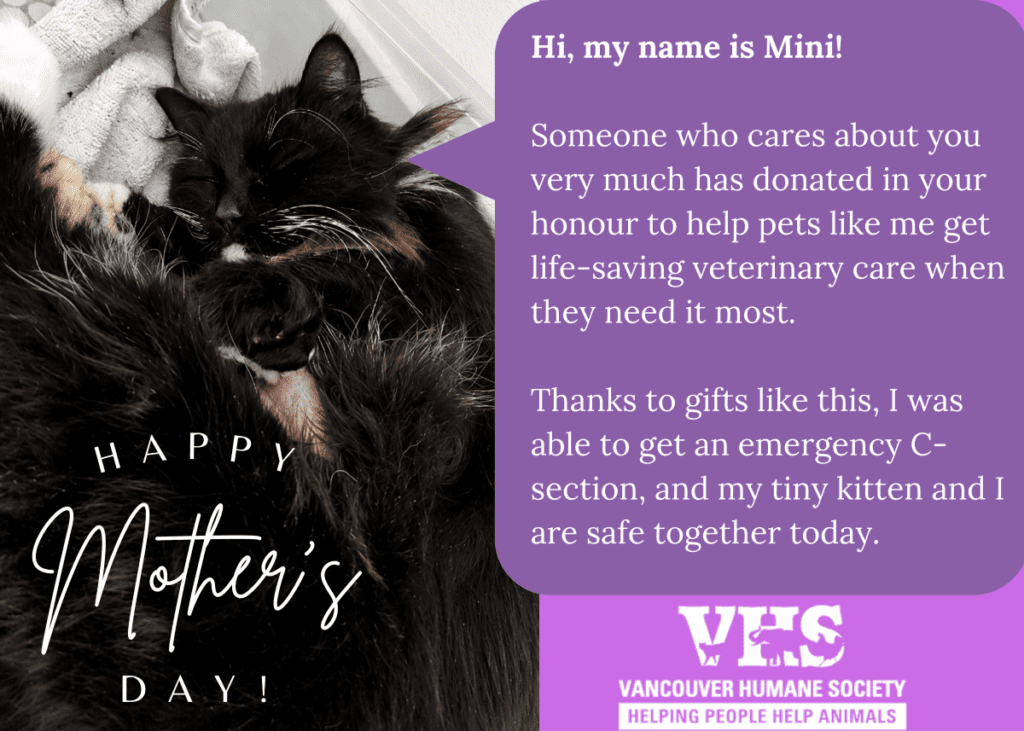
To send an e-card with your kind gift, tick the “Yes, I want to dedicate my donation” box in the “Want to dedicate your gift to someone special?” section of the online donation form. Then, select “In Honour Of”.
Donate to help pets like brave mama Mini this Mother’s Day
Mini was a former feral barn cat who found a loving home with Kelly. When Mini went into labour at home, it quickly became clear something was wrong. Kelly rushed her to the vet and reached out to the Vancouver Humane Society’s McVitie Fund for help.
At the clinic, vets were able to get Mini into emergency C-section surgery, saving her life and delivering one tiny kitten. Today, Mini is safe, her tiny kitten is by her side, and Kelly’s family is full of gratitude.When you make a gift to the McVitie Fund, you can also send a thoughtful e-card featuring Mini to someone you love. Your donation will help more animals like Mini receive life-saving veterinary care when they need it most.
Simply tick the “Yes, I want to dedicate my donation” box in the “Want to dedicate your gift to someone special?” section of the online donation form. Then, select “In Honour Of”.
Right now, gifts to the McVitie Fund will be matched up to $30,000 by a generous anonymous donor, doubling your impact for animals like Mini.
Your love will keep families like Kelly’s healthy and together.
Credit: Aaron Gekoski / Asia for Animals Coalition / We Animals
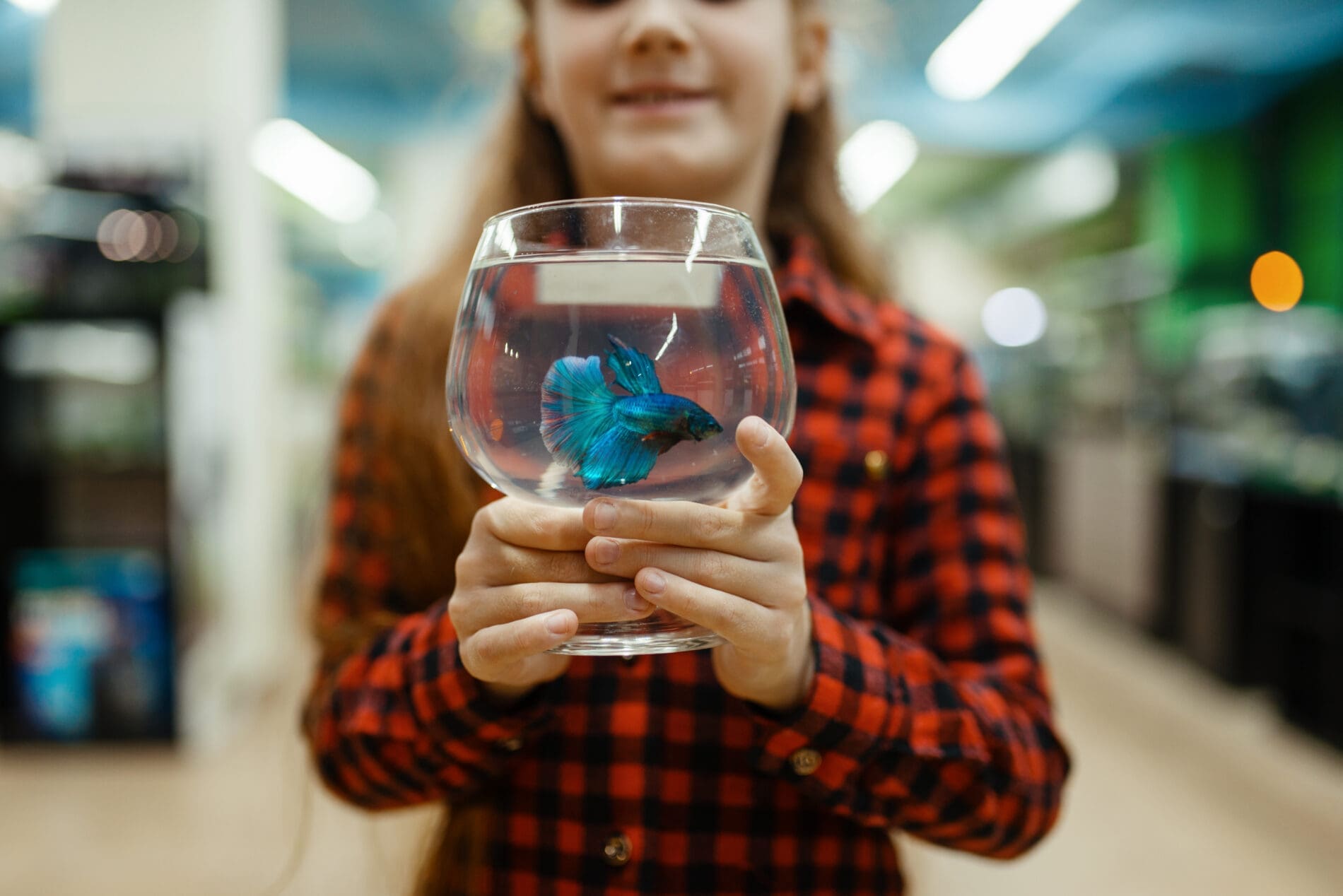
Bright aquariums filled with colourful fishes are often seen as calming, decorative additions to a home. But behind the glass is a reality that is far less visible.
Ornamental fishes are among the most widely kept exotic animals in the world, and often considered a ‘starter pet’, yet their welfare is frequently overlooked.
The ornamental fish trade is a global industry involving thousands of species and billions of animals. One recent review estimates it includes close to 6,000 species and generates over $15 billion USD annually. Common species that many are familiar with include Goldfish, Bettas, and Tetras.
Many of us have seen fish in pet stores, carnivals, and homes, but how many of us know where they actually come from?
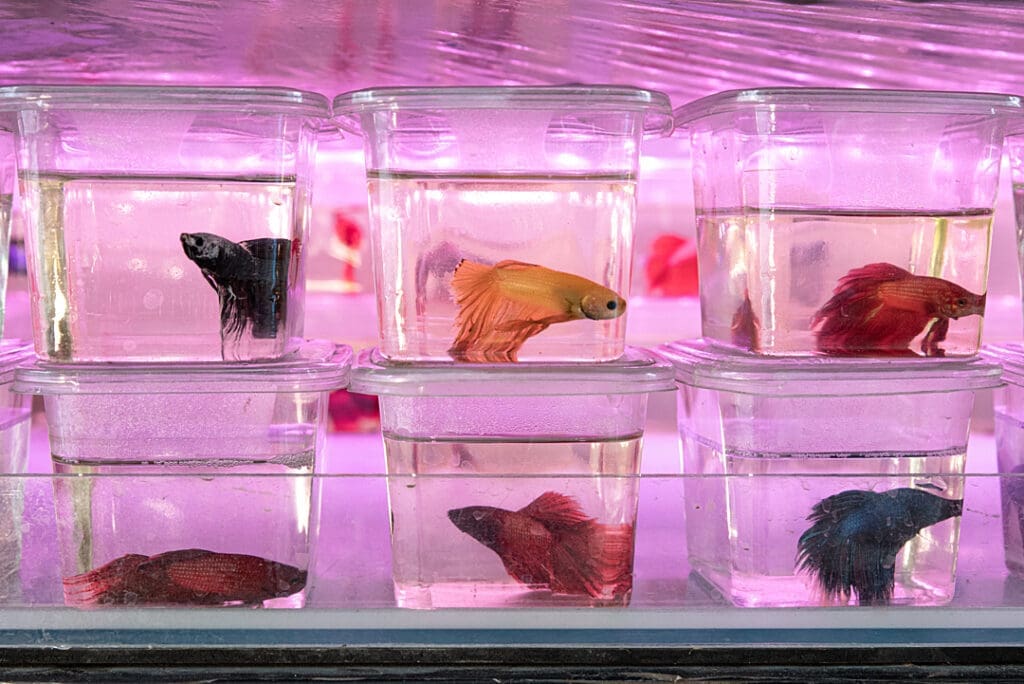
Fish are then transported to be purchased by customers to places like pet stores or hobbyists.
3
Most will die during transit
It is estimated that over 90% of fish will die during transportation, and a large proportion will be discarded for issues that customers find unattractive, such as wounds or a sickly appearance.
4
Waiting on store shelves
The survivors will be stored in holding tanks until they are purchased.
5
Living in a tank until death
Their final stage of life is often in a customer’s home aquarium, where they live until death.
Yet fish are still widely perceived as low-maintenance pets, or even as decoration. This misunderstanding has serious consequences for their welfare. When their needs are underestimated, they are more likely to be impulsively purchased or kept in environments that compromise their health and well-being.
Credit Jordan Rivers / We Animals
Life in a tank is more complex than it looks
Unlike many other companion animals, fish live entirely within aquatic environments constructed and maintained by humans. This makes water quality one of the most critical factors in their welfare.
In their natural habitats, fish have expansive space and enriched ecosystems that are often difficult to replicate in captive environments. Properly caring for fish can be intensive, making the myth that they are easy to care for ‘starter pets’ particularly harmful.
A fully “cycled” tank that supports the nitrogen cycle
Many common health issues seen in ornamental fishes are directly linked to poor husbandry. From a veterinary perspective, treatment often depends on correcting the environment rather than simply administering medication. This requires ongoing knowledge and commitment from caregivers, something many are not prepared for when they first acquire fish.
There are barriers to veterinary care
Even when problems are recognized, access to veterinary care can be limited. Aquatic medicine is a specialized and relatively niche area, and many general veterinarians are not equipped to treat fish patients.
This creates a difficult situation. Fish may suffer from preventable conditions, while caregivers struggle to find guidance or support.
At the same time, the sheer diversity of species in the trade makes it challenging to develop consistent care standards. Different species have different environmental and social needs, and many are unlikely to have those needs fully met in typical home aquariums.
A welfare issue we can no longer ignore
The ornamental fish trade highlights a broader issue in how animals are perceived and treated. When animals are seen primarily for their appearance or being easy to care for, their needs can be overlooked.
Fish are sentient individuals capable of experiencing stress and suffering. Their welfare matters, both in the conditions they are kept in and in the systems that bring them into our homes.
Here’s what can you do to help!
Improving the lives of ornamental fish takes all of us!
1
Educate yourself & others
If you choose to purchase fish, learn about their complex welfare and husbandry needs, and about veterinary care options near you.
2
Share this post
Educate others on the welfare needs of fish so they can make informed decisions before purchasing animals.
3
Local advocacy
Talk to pet stores and local representatives in your community to advocate against the sale of fish in pet stores or for improved welfare conditions.
4
Sign up to take action ↓
Sign up for our mailing list to be informed when opportunities to advocate for fish arise.
At VHS we believe all animals deserve care, respect, and consideration. That includes fish, whose needs may be less visible but are no less important. By looking beyond the surface, we can begin to change how ornamental fish are understood and treated and ensure their lives are more than something to look at.
The Rideau Carleton Raceway is shutting down its horse racing program, the raceway’s operators say.
Following the closure of both B.C.’s active horse racing tracks in 2025, another racecourse in Ontario has announced an end to its horse racing program.
“The Rideau Carleton Raceway is shutting down its horse racing program, the raceway’s operators say.”
The closures come as a result of waning public support and declining revenues, which have been making the industry unsustainable at various locations. Though these horses will move to other racing venues in Ontario, the closure signals a hopeful shift in public attitudes around the use of animals in risky sporting events.
Horse racing poses serious welfare concerns due to:
Common incidents of injury and death for horses;
Issues with selective breeding—thoroughbred horses are often overbred for speed rather than skeletal strength, making their legs susceptible to fatal injury;
Young starts to horses’ short racing careers, which puts them at high risk and can cause early decline;
Aversive training methods and uncomfortable equipment, like whips and tight bits, which can cause stress and pain.
These welfare concerns put horses at risk of an uncertain future, as do the track closures that result from declining revenues and public support. As such, industry professionals should transition away from breeding new animals into an unstable future and plan for a compassionate retirement for horses who may be impacted by closures.
This progress would not have been possible without compassionate people like you.
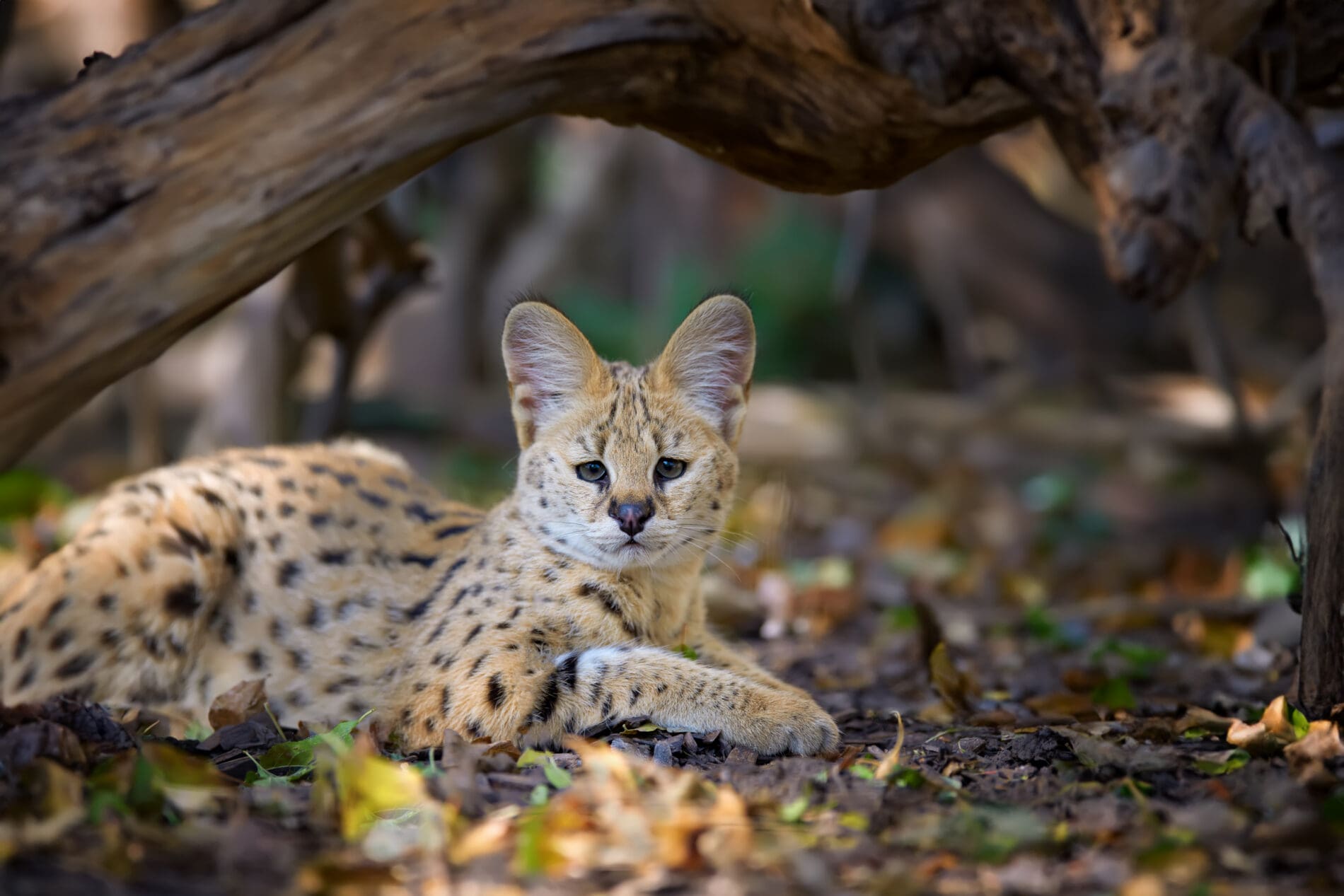
Over the past year, the VHS and supporters spoke up for animals by contacting decision makers and participating in a public consultation on a proposal to ban exotic cats. Your voices helped show the province that British Columbians want stronger protections for wild animals.
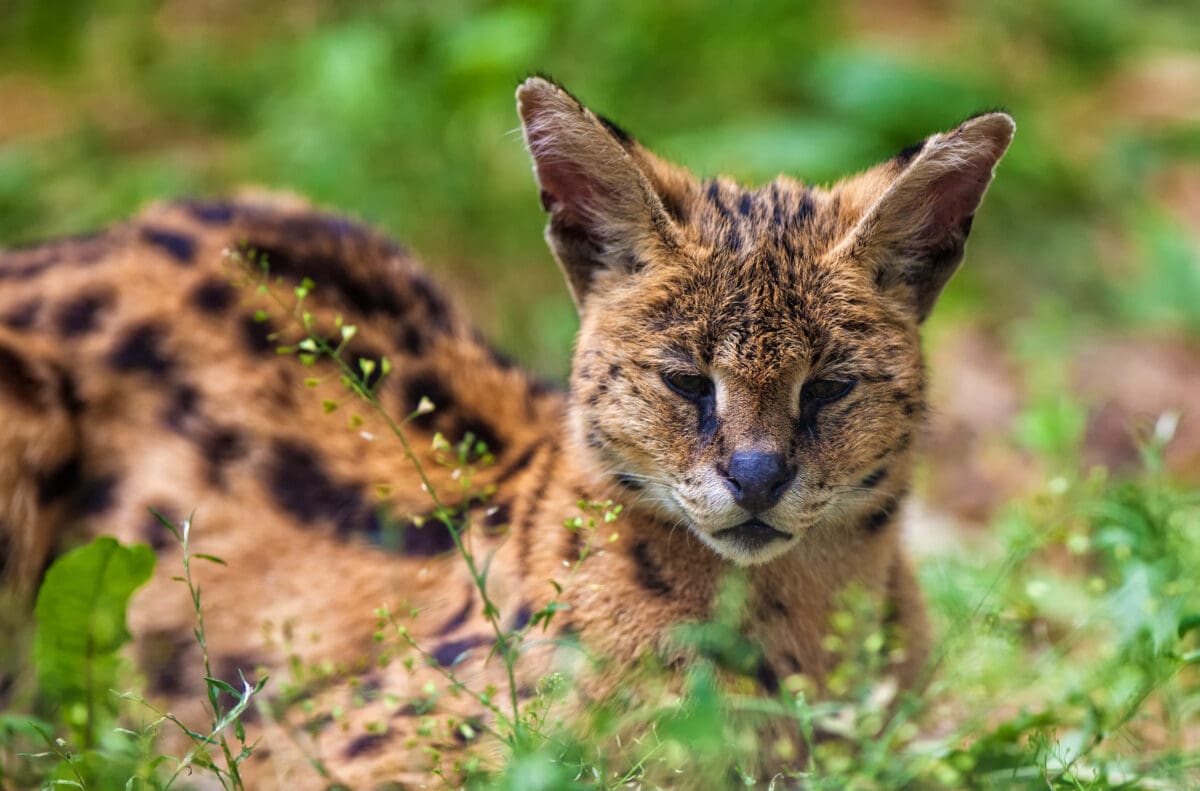
Exotic cats are wild animals with complex physical and behavioural needs that cannot be met in a household environment. Even when bred in captivity, they retain the instincts and behaviours of their wild counterparts.
They are driven to roam, climb, hunt, and defend territory. Confinement in homes can lead to severe stress, behavioural problems, and poor health.
Exotic cats require specialized diets and veterinary care that are not widely available.
Servals and caracals can weigh up to 40 pounds and have a bite force far stronger than a domestic cat. When exotic cats escape or are released they can harm other animals and pose risks to the community.
For these reasons, exotic cats experience poor welfare when kept as pets and can create risks for people, other animals, and local ecosystems.
What do the new rules mean?
Under the planned changes to the Controlled Alien Species Regulation (CASR), all exotic cat species will be prohibited in the future.Breeding, selling, or acquiring new exotic cats will no longer be allowed.
Animals already in private homes will be permitted to stay with their current guardians for the remainder of their lives, provided that guardians obtain a permit and follow basic care and safety requirements.
This change is designed to ensure that no more exotic cats are brought into captivity as pets where their needs cannot be met.
A meaningful step, with more work ahead
While this ban is an important step for advancing animal welfare, many other exotic species continue to be kept as pets in B.C. despite facing similar welfare concerns.
The VHS is encouraging the provincial government to go further by adopting an evidence-based positive list system for exotic animals. Instead of a long list of banned species, a positive list allows only animals that are proven suitable as pets based on animal welfare, public health, safety, and environmental criteria.
The VHS applauds the provincial government for taking this important step towards advancing animal welfare by banning exotic cat ownership and hopes to see more positive changes.
When people speak up for animals, change happens!
Thank you for helping make the exotic cat ban possible by standing up for animals who cannot speak for themselves.
TAKE ACTION! Help take the next step for animals
We invite you to help move this work forward by encouraging the provincial government to implement stronger rules for exotic animals in line with UBCM Resolution NR75.
Together, we can help ensure that wild animals are not kept in conditions that compromise their welfare or threaten public safety.
Why do we underestimate cattle? Many choose to think of “edible” animals as unintelligent, but in the case of cattle, research proves otherwise.
New research featured in Psychology Today is bringing cow intelligence into the spotlight, increasing awareness around these sensitive and sentient animals.
As animal allies, we know that animals think and feel, whether they share our homes like cats and dogs or are killed for food like cows, pigs, and chickens. However, awareness around farmed animal sentience remains sparse and cognitive dissonance is common.
Research on animal intelligence helps more people to understand that animals are capable of complex thinking, problem-solving, emotions, and even social relationships. As this evidence becomes more widely understood, it challenges outdated views of animals as simple or unfeeling and highlights their capacity to experience stress, pain, and well-being in meaningful ways.
This growing awareness encourages the public and decision-makers to reconsider how animals are treated, supporting a shift toward animal-free eating habits and stronger welfare standards.
Read the article in Psychology Today to learn what a free-living herd of domesticated cattle can teach us about cow intelligence and adaptability.