
This petition is now closed. Thank you to everyone who signed and spoke up for animals. Please go to this page for current campaigns.
The Vancouver Humane Society is joining The Fur-Bearers and advocates across Canada in calling for an end to fur farming for all species in Canada.
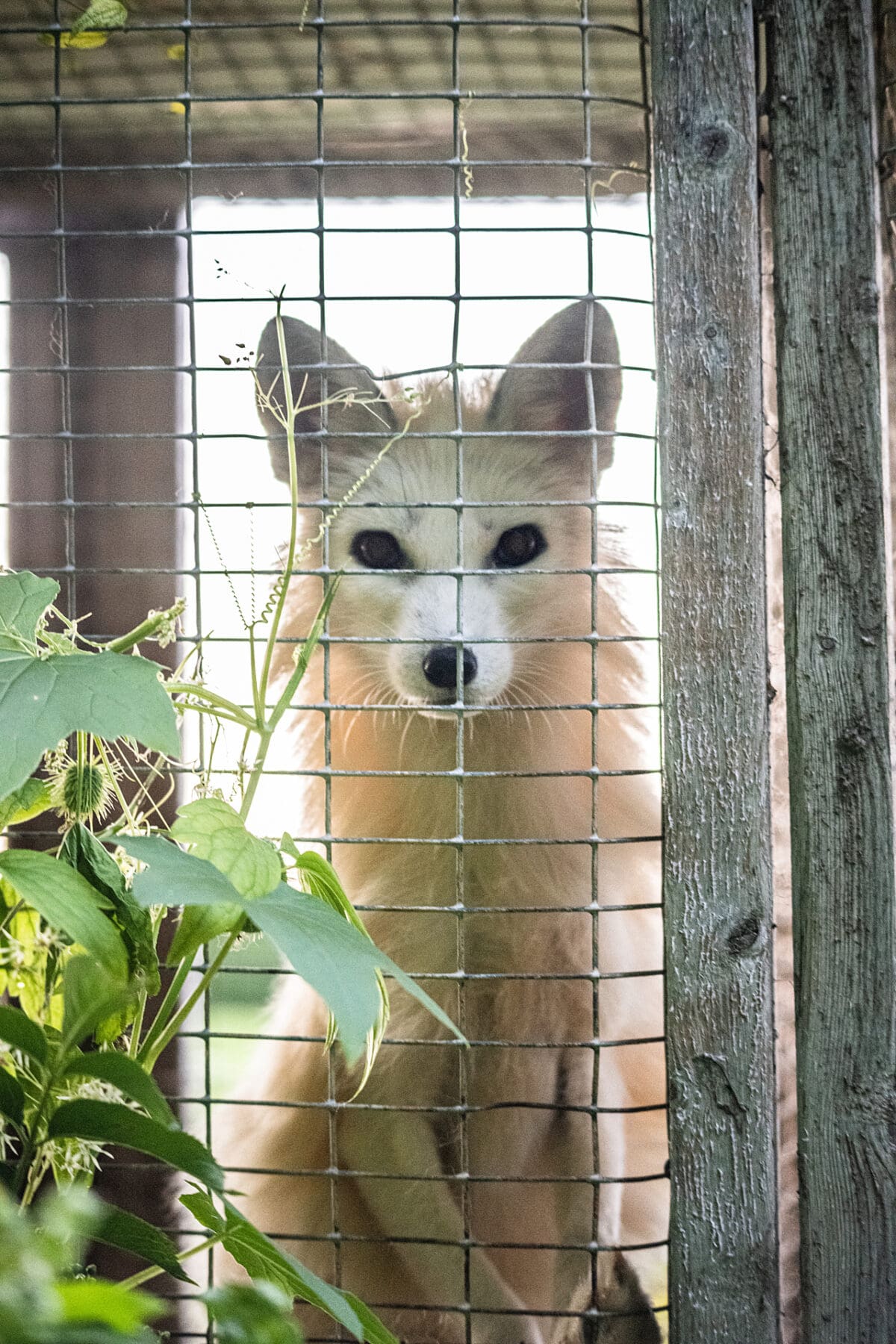
Wild animals confined on fur farms are kept in cramped and inhumane conditions to be killed for non-essential fur products.
The Province of British Columbia has banned fur farming of minks due to public health risks, but many animals continue to suffer across the country.
TAKE ACTION: Canadian residents can sign the official parliamentary e-petition until August 17, 2025. After you sign, be sure to click the link in the confirmation email so your signature is counted.
You can also use the quick action tool from The Fur-Bearers to send an email to federal decision-makers calling for change.
Join the Vancouver Humane Society, The Fur-Bearers, MP Gord Johns, and advocates across Canada in calling to protect wild animals farmed for their fur.
Sign the federal e-petition on the Parliament of Canada website before August 17, 2025, at 11:40 a.m. PT.
Important: After you sign the petition, be sure to check your email and click the confirmation link to ensure your signature is counted.
The feedback period for the Pig Code of Practice is now closed. Thank you to all who spoke up for pigs!
The National Farm Animal Care Council’s (NFACC) Pig Code of Practice, last updated in 2014, was up for review until June 4, 2025.
The code of practice serves as a guideline for the on-farm care and handling of pigs raised in Canada.
There are many significant welfare issues associated with the current pig code of practice, including: extreme confinement; lack of opportunities to engage in natural behaviour; lameness and injury; unnecessary painful procedures; and inhumane forms of on-farm euthanasia.
Hundreds of advocates spoke up for pigs, submitting their top welfare concerns with help from the VHS’s tip sheet.
Keep an eye out for the next public feedback stage around fall 2026 to winter 2027, when NFACC will release specific updates for comment.
Thank you! The 5-minute survey to speak up for millions of pigs is now closed.
Read the top welfare concerns for pigs
Advocates filled out a short survey and shared their top 3 concerns for pig welfare. Scroll down to read a few of the top welfare issues the VHS recommended for consideration.
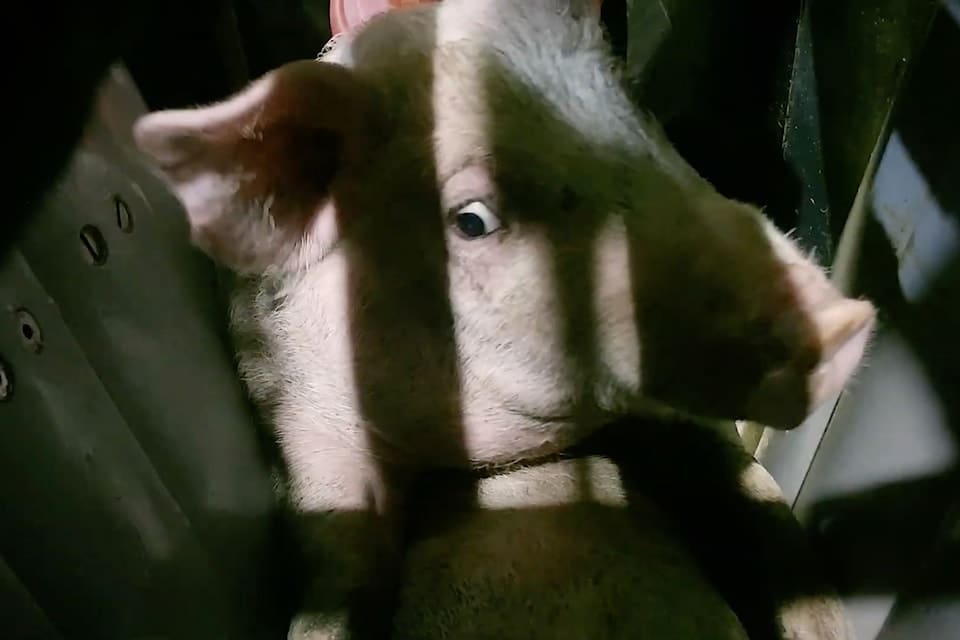
Photo: Jo-Anne McArthur/We Animals
Note: Click or tap to expand images. Though the images do not show graphic violence or injuries, they depict animal suffering and may be upsetting to some viewers. All photos were taken on Canadian pig farms between 2020 and 2022.
Top welfare priorities
Extreme confinement
Recommendation: End extreme confinement, including use of gestation and farrowing crates.
Background: Gestation and farrowing crates are used to isolate and confine individual pigs who are pregnant (gestation crates) and ready to give birth and nurse piglets (farrowing crates).
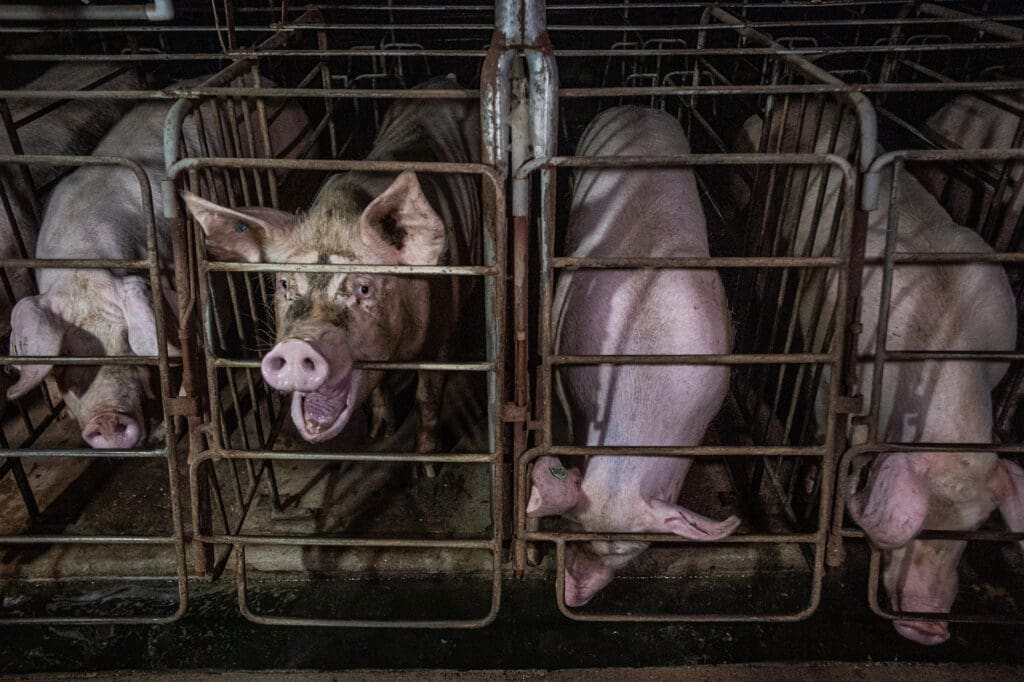
Both types of enclosures are so small and narrow that the mother pig can only stand up, lie down, and take a few steps forward or back, but cannot turn around.
Click for image of gestation crates
Jo-Anne McArthur/We Animals
On an industrial pig farm, a sow chews repetitively on the metal bars of her gestation crate while her neighbours drink accumulated water from a channel that runs in front of their enclosures. Sows confined inside these bare, concrete-floored enclosures can sit, stand and lie down, but they cannot walk or turn around. Quebec, Canada, 2022.
Lack of space & enrichment
Recommendation: Require more space and species-specific enrichment opportunities to engage in natural behaviours.
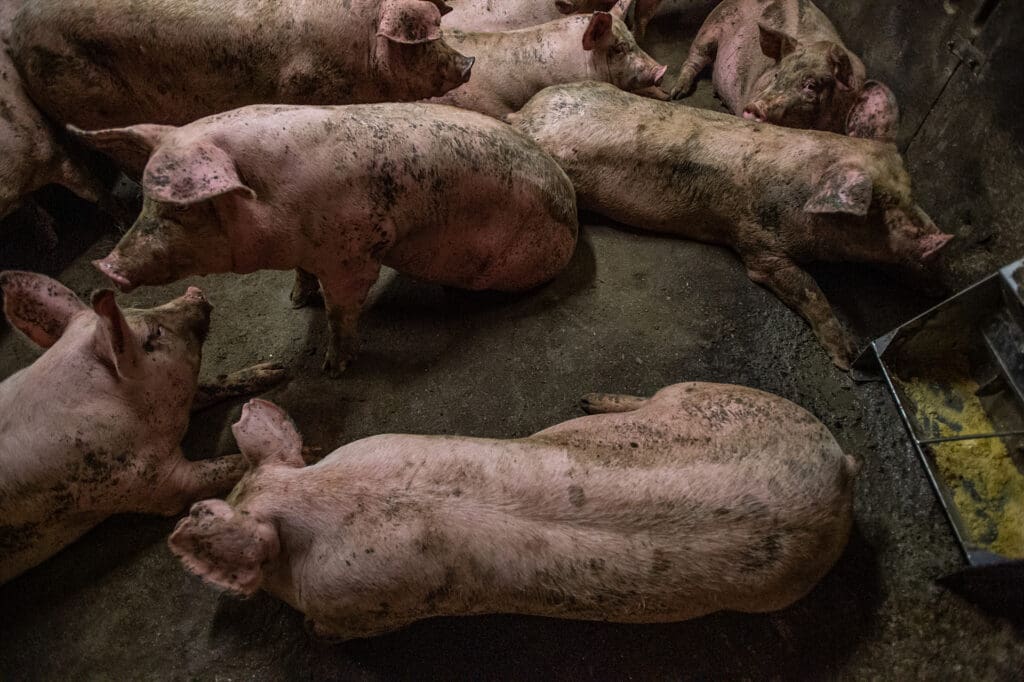
Background: Inadequate space and overcrowding can contribute to stress, aggression, injury and lameness and restrict the ability to engage in important natural behaviours.
Appropriate environmental enrichment is crucial for allowing pigs to express species-specific natural behaviours (e.g. rooting, chewing, exploring) and prevent boredom, stress and abnormal behaviours. Appropriate nesting materials are also a crucial form of enrichment for pregnant pigs.
Click for image of a crowded industrial pig farm
Jo-Anne McArthur/We Animals
Young pigs live in compact pens inside this industrial farming facility. The windows open to the hallway and not to the outdoors, and investigators confirm that the pigs live in complete darkness except for when a farm hand enters the rooms. Canada, 2020.
Unnecessary painful procedures
Recommendation: End painful procedures, such as castration, tail docking, teeth clipping, and ear notching.
Background: Pigs can experience acute and chronic pain during and after these unnecessary procedures. Current pain control requirements do not account for both acute and chronic pain. For instance, castration for piglets younger than 10 days of age requires the use of analgesics (for lasting relief), but anesthetics (for immediate pain) are only “recommended”.
Click for image of pigs with docked tails
Jo-Anne McArthur/We Animals
Pigs can be seen with docked tails on an industrial farm. Tail docking of pigs does not require anesthetics for acute pain control. Canada, 2020.
Inhumane forms of euthanasia
Recommendation: Ban euthanasia by blunt force trauma.
Background: Blunt force trauma, usually striking the piglet’s head against a hard surface or with a blunt instrument, is an approved method of euthanizing piglets under the current code of practice. This unethical practice presents significant welfare risks and places an emotional burden on handlers.
Click for image of piglets on a farm
Jo-Anne McArthur/We Animals
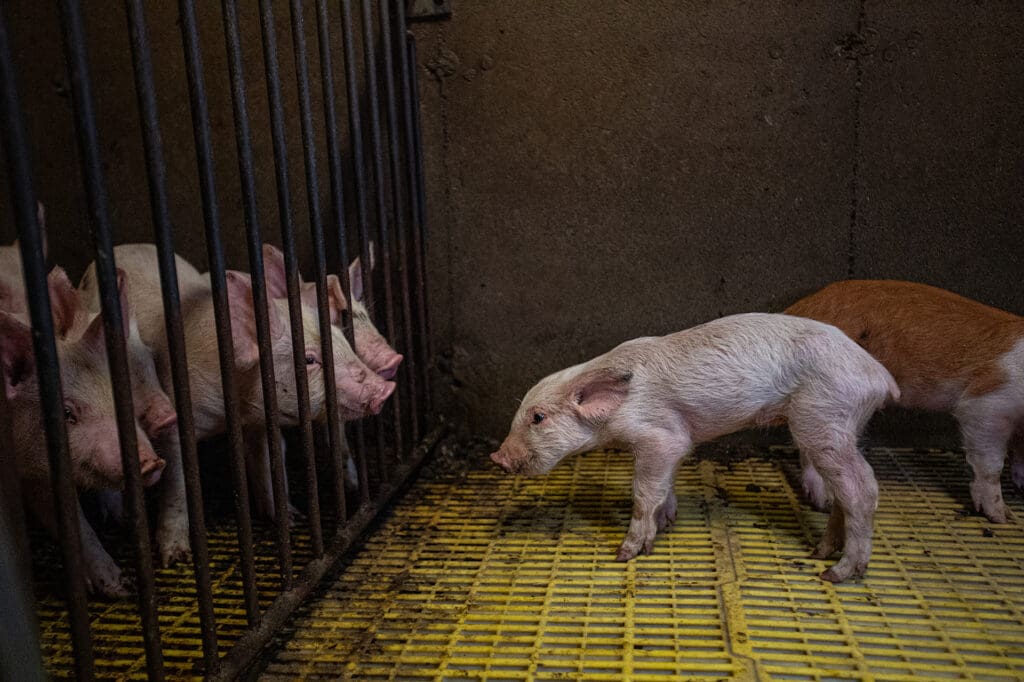
Curious piglets look at one another from inside a small pen. The pig on the right is ill and thin. At this farm, there are no windows facing the exterior and the pigs live in darkness. Canada, 2020.
Lameness & injury
Recommendation: Improve flooring, bedding and housing conditions to reduce lameness and injury.
Background: Concrete, slatted flooring has been identified as a major contributor to lameness and injuries in pigs. Improved flooring requirements are needed to reduce the incidence of lameness and injury and to ensure pigs can move freely and lie down and rise comfortably.
Access to bedding, such as straw or shavings, can provide thermal comfort, cushioning and enrichment opportunities.
Click for image of piglets on a slatted floor
Jo-Anne McArthur/We Animals
Slatted floors can be seen in this pig farm that houses more than one thousand pigs in a windowless building. Investigators told We Animals Media they had visited this farm many times and confirmed that the lights inside the building were only turned on when people briefly entered to check on and feed the pigs. Canada, 2020.
Recently, the Vancouver Humane Society sent a letter to the B.C. Minister of Agriculture calling for urgent changes for farmed animals in response to shocking footage reportedly taken at a B.C. slaughterhouse. The Ministry has since responded to the VHS and not acknowledged the urgency to protect farmed animals in the wake of this horrific footage. Instead, the government continues to delay action on moving forward with recommendations on B.C.’s Farmed Animal Framework. Can you send a message urging the Minister to prioritize stronger protections for farmed animals?
In January, Chilliwack-based pig slaughterhouse Johnston’s Meats was ordered to take “corrective actions” after shocking footage released by Animal Justice showed horrific suffering.
The disturbing footage shows frightened and panicked pigs being inhumanely handled, including:
Animals being improperly stunned before having their throats cut, being hung upside down to bleed out while conscious, and then placed into a scalding tank of boiling water.
Multiple animals appear to show signs of consciousness after being electrocuted, which is required to render them fully unconscious for the rest of the slaughter process.
In some clips, workers are seen slitting still-conscious pigs’ throats and electrocuting them multiple times.
Despite this, the Ministry of Agriculture said no illegal behaviour was found, and that the footage depicted “standard practices in a busy hog processing facility.”
Calling for action from the B.C. government
The investigation and the Ministry’s response raised serious concerns, leading the VHS to send a letter to Premier David Eby and Agriculture Minister Lana Popham.
The letter:
Detailed the shocking suffering of pigs seen in the footage released by Animal Justice and the history of near-annual investigations at B.C. farms and slaughterhouses over the past decade.
Highlighted “that slaughterhouse inspectors, who are required to be on-site daily, failed to identify and report the issues captured in the footage … This raises serious questions about the effectiveness of current oversight and enforcement activities.”
Urged the Premier and Agriculture Minister to prioritize next steps following the province’s recent review of its farmed animal welfare framework, including government-mandated and proactively enforced regulations based on the best available animal welfare science; proactive oversight including “consistent video surveillance”; and appropriate penalties to prevent cruelty and ensure accountability.
The Ministry of Agriculture has refused to acknowledge the urgency of this situation as farmed animals continue to suffer.
Could you please take the action below and tell the Ministry animal protection should be a priority?
Note: A valid Canadian postal code is required to send messages to Canadian decision-makers. If you do not have a postal code, you can reach Premier David Eby by email at Premier@gov.bc.ca and Agriculture Minister Lana Popham at AF.Minister@gov.bc.ca.
This petition is now closed. Thank you to the 7,058 people who spoke out against inhumane fur farming!
Photo: We Animals
The Vancouver Humane Society is joining The Fur-Bearers and other organizations across Canada in calling for a national prohibition on fur farming in Canada.
Fur farming causes significant animal suffering and poses serious risks to public health and the environment for the sake of luxury fashion items.
More than 20 countries have already banned fur farming or introduced legislation to do so in the coming years.
A new federal e-petition, launched by The Fur-Bearers, calls on the Canadian government to ban fur farming for all animal species across the country.
TAKE ACTION: Canadian residents can sign the official parliamentary e-petition until January 27, 2025. After you sign, be sure to click the link in the confirmation email so your signature is counted.
Call on the Canadian government to ban cruel fur farming
Join the Vancouver Humane Society, The Fur-Bearers, MP Gord Johns, and other organizations in urging the federal government to end fur farming across Canada.
Sign the federal e-petition on the Parliament of Canada website before January 27, 2025, at 6:48 a.m. PST.
Important: After you sign the petition, be sure to check your email and click the confirmation link to ensure your signature is counted.
Inhumane fur farming persists in Canada despite widespread opposition
There are close to 100 fur farms left in Canada. Animal species that are farmed for their fur include mink, fox, wolves, bobcats, lynxes and chinchillas.
Although British Columbia banned mink fur farming in 2021, farming other species for their fur is still allowed in the province. There are currently no prohibitions at the national level.
Polling from 2024 revealed that 78% of Canadians and 81% of British Columbians are against killing animals for their fur.
Animal welfare concerns
On fur farms, animals are kept in small, wire cages for the entirety of their lives, depriving them of the ability to engage in natural behaviors typical in the wild. This can lead to stress, stereotypic behaviors, and self-mutilation.
Warning: The following video contains graphic footage. Viewer discretion is advised.
Over the past several months, The Association for the Protection of Fur-Bearing Animals obtained footage from inside Canada’s fur farms. This second video shows never-before-seen images of fox and mink suffering in deplorable conditions. Please join us and take the pledge to #MakeFurHistory at www.MakeFurHistory.com.
Public health risks
Animals confined in fur farms have been shown to be hosts for zoonotic diseases. For example, during COVID-19, deadly outbreaks were seen in fur farms globally, including locally in the Fraser Valley. Millions of animals were culled in an attempt to control the spread of the virus.
Environmental degradation
Manure runoff from large industrial fur farms pollutes nearby soil and bodies of water, threatening local animal populations, humans, and ecosystems.
Visit furfarming.ca to learn more about The Fur-Bearers’ campaign to ban fur farming across Canada and the organizations that have signed on in support.
Metro Vancouver is updating the Regional Food System Strategy for the first time since 2011 and is seeking public input.
This is an important opportunity for Metro Vancouver residents and food system stakeholders to advocate for a shift toward more humane, healthy and sustainable plant-based food production and consumption across the region.
TAKE ACTION: If you’re a Metro Vancouver resident, your input is needed to help advocate for an updated strategy that prioritizes less animal-based products and more plant-based foods. Share your feedback in the online survey before the deadline of December 31, 2024.
Below are the main questions included in the Metro Vancouver survey. Click on each key point for tips and context to help answer the questions in your own words.
1. What changes have you seen in the regional food system over the last 10 – 15 years?
(Examples: changes to imports/exports, climate considerations, community changes, consumer habits, costs, etc.)
Growing public awareness and concern about the impact of animal-based foods…
…on the environment, health, and animal welfare, resulting in more people reducing their consumption of animal products.
A 2022 survey of Lower Mainland Residents found that 65% of respondents have reduced their consumption of animal products.
A 2019 survey found that 25% of B.C. residents have tried a vegetarian diet, compared to the national average of 18%.
A 2018 survey found that almost 40% of British Columbians aged 35 and under follow a vegetarian or vegan diet, more than three times higher than the national average.
Increased demand for plant-based foods/beverages…
…and more products being offered in stores, restaurants, etc.
A 2022 survey found that 65% of respondents in the Lower Mainland would eat more plant-based meals if there were more tasty options available when going out to eat.
Scientific research and experts urging all levels of government to support food system change…
…toward plant-based eating patterns.
Growing awareness that the type of food plays a much larger role in a food’s overall carbon footprint than the distance it travels. Previously, much of the focus has been on prioritizing local food, but it’s also increasingly important that plant-based food be incorporated into food system strategies.
Food system change, including shifting toward plant-based diets, is necessary to meet global climate targets and stay below 2 degrees of global warming.
In the City of Vancouver, nearly 98% of the ecological footprint of food comes from the land and energy used for growing and producing it, particularly red meat and dairy products.
Government acknowledgement and action around the need for food system change…
…toward more plant-based foods.
The City of Vancouver passed a motion declaring the various social, economic, and environmental benefits of plant-based procurement.
The District of North Vancouver passed a motion to ensure plant-based options are included and prioritized at municipal events, meetings, and other gatherings where the District purchases food.
Public support for government action…
…including meat reduction efforts incorporated into government strategies.
In a 2022 survey of Lower Mainland residents, 58% of respondents would support shifting government subsidies from animal-based food production to plant-based food production.
60% of survey respondents would support including animal production-reduction efforts into local, provincial and federal climate, health and animal welfare strategies.
Are there any other food system-related changes or trends you’ve noticed in the Lower Mainland over the last decade?
2. What do you think the role of Metro Vancouver should be in the implementation of a regional food system strategy?
(Examples: protecting agricultural lands, convening member jurisdiction on specific issues, providing local research and data, public education, etc.)
As a regional organization, Metro Vancouver and member jurisdictions can prioritize humane, healthy and sustainable plant-based foods across the supply chain.
This could include:
Prioritizing and incentivizing plant-based food production and processing.
Supporting partnerships that enable businesses, public institutions and others to collaborate on plant-based procurement throughout the region through bulk ordering and supplier connections.
Public marketing, education, and promotion around increasing plant-based food consumption, in alignment with the updated Canada Food Guide, which recommends choosing plant-based proteins more often.
Supporting more plant-based options in food service, including through public institutions like schools, hospitals and community centers, as well as in catering, corporate programs, and cafeterias.
Supporting consumption of more plant-based foods across consumer, corporate, business and institutional levels.
Are there other food system-related roles you think Metro Vancouver should be involved in?
3. Is there any other feedback or other information you would like to share?
Metro Vancouver is uniquely positioned to support a much-needed food system shift towards plant-based food across multiple sectors.
This could include strategies and practices such as:
Promoting and supporting strategies that prioritize plant-based food choices. For example, setting plant-based meals as the default option at events, meetings and municipal facilities.
Incentivizing plant-based food production, processing, purchasing and procurement. For example, through municipal food service contracts.
Encouraging member jurisdictions to set a target for reducing the volume of animal products purchased at municipal levels and follow the lead of other jurisdictions that have implemented meat reduction and/or plant-forward strategies.
Are there other food-system related ideas or examples you would like to share?
In a letterto the Canadian Senate, 30+ Canadian celebrities, 20+ veterinary and animal welfare experts, and more than a dozen animal advocacy organizations have called for an end to the cruel export of live horses abroad for slaughter.
Bill C-355, which would ban the cruel practice, got through the House of Commons but has been stalled in the Senate since May.
Recent investigations and Japanese government data show the suffering far exceeds what the Canadian Food Inspection Agency (CFIA) claims.
While the Senate delays action, horses continue to suffer and die as shipments continue.
TAKE ACTION: Use the quick action tool below to send a message to Canadian Senators in your province, urging them to move forward with bill C-355 without further delay.
Join Canadian celebrities, experts and advocates in urging the Senate to stop the deadly delay.
Take the quick action to email Canadian Senators
Use the email template below to send a message to Canadian Senators in your province, calling on them to move forward with bill C-355 without further delay.
Tip: For added impact, edit the template message below to personalize your email.
Note: Click here for individual contact info of Canadian Senators.
Canadian icon and multi-platinum artist Jann Arden, along with a host of celebrity signatories including Bryan Adams, Chantal Kreviazuk, Elisha Cuthbert and Queen’s Brian May have penned a letter imploring Canada’s Senate to move forward with Bill C-355, the Prohibition of the Export of Horses by Air for Slaughter Act. The letter (which can be found here) also has strong support from the Canadian acting community, including stars in shows like Star Trek: Discovery, The Handmaid’s Tale, Workin’ Moms, and Heartland.
More than 20 veterinary and animal welfare experts, and more than a dozen animal advocacy organizations have also signed the letter urging senators to study and pass this lifesaving bill, which was passed by the House of Commons in May.
“Since 2006, tens of thousands of terrified horses have been crammed into shoddy wooden crates and flown 8,000 km to their demise, enduring turbulence, thirst and hunger, and abject fear,” said Jann Arden. “To say this practice is inhumane would be an understatement. Canadians want this to end.”
Bill C-355 was introduced last September by federal MP Tim Louis to end the abhorrent practice of shipping horses from Canada overseas to Japan for slaughter. The Bill is being delayed by a handful of Senators and has seen little progress in the Senate since May. The clock is ticking – if the bill is to become law it must pass before the next federal election.
Tens of thousands of Canadians have called and written to Senators, urging them to study and pass the bill. Yet as the legislation remains in limbo, these shipments continue to be sent overseas for slaughter, with horses enduring gruelling journeys. Most shipments appear to go over the legal limit of 28 hours without food, water, and rest.
Shipments continue despite the revelations uncovered through recent investigations by Animal Justice and Japan-based Life Investigation Agency. Based on Government of Japan records, between June 2023 and May 2024 alone, at least 21 horses exported for slaughter died during transport or in the hours and days shortly thereafter.
More than 50 others were injured or became seriously ill during this time. None of these injuries, illnesses, or deaths were reported to Canadian officials.
Bill C-355 reflects a promise made to Canadians during the last federal election, and enjoys broad public support across the political spectrum. With a pending election expected in 2025, Ms. Arden and the letter’s numerous other signatories are gravely concerned about the Senate’s delay in studying and ultimately passing this crucial legislation.
The feedback period for transparent labelling on egg products is now closed. Thank you to all who spoke up for transparency for egg-laying hens!
The Canadian Food Inspection Agency (CFIA) is looking for public feedback on proposed guidelines for how plant-based egg products can be labelled.
While the intention is to prevent false or misleading advertising of plant-based products, research shows that consumers find labelling of eggs from chickens confusing.
TAKE ACTION: Your input is needed to help advocate for fair and transparent labelling standards among all egg products in Canada. Share your feedback in a quick email before the consultation deadline of October 28th.
Terms such as free-range, free-run, cage-free and enriched colony housing have no legal definitions. These terms, along with marketing tactics such as labels with images of happy hens frolicking in the grass, are misleading when compared to the on-farm conditions and methods of production.
Tip: Share your own experience with chicken egg labelling. Have you found it confusing to understand the welfare information and method of production (caged vs. cage-free eggs) of eggs at your grocery store?
Egg product labelling should include welfare information and method of production
Research shows that a majority of Canadian consumers think about animal welfare when deciding what eggs to purchase. The majority are willing to spend more when they believe the hens’ welfare is higher.
Consumers and advocates are increasingly calling for in-store egg labelling that includes animal welfare and method of production (e.g. caged vs. cage-free) information.
Fairness in labelling for ALL egg products
Guidelines for plant-based egg labelling must be fair and not put plant-based products at a disadvantage to animal-based products. Efforts to prevent misleading advertising and improve transparency must apply to ALL egg products.
Have more time? You can learn more about the proposed guidance on plant-based egg labelling and submit your feedback via the online feedback questionnaire, which includes more questions.
Update: The online questionnaire is now closed. Thank you to all who participated.
The feedback period for the Chicken and Turkey Code of Practice is now closed. Thank you to all who spoke up for chickens and turkeys!
The National Farm Animal Care Council’s (NFACC) Chicken and Turkey Code of Practice, which serves as a guideline for on-farm care and handling of birds raised for meat, is coming up for review for the first time since 2016.
A short public survey will help determine the top priorities for the code review.
The current code allows for many inhumane practices that compromise the welfare of chickens and turkeys in the poultry industry.
In 2023, more than 780 million chickens were raised and killed for meat in Canada, representing the vast majority of animals farmed for food nationwide.
TAKE ACTION: Take the 5-minute survey to speak up for hundreds of millions of individual animals.
Share your top welfare concerns for chickens and turkeys
Take the short survey to share your top 3 welfare concerns for chickens and turkeys raised for meat in Canada. The deadline to participate has been extended to November 8, 2024.
Lower the stocking density of birds on poultry farms and provide them with more space to move freely and exhibit natural behaviors.
Overcrowding in chicken and turkey farms in Canada presents significant welfare and health concerns for the birds. Intensive farming practices, driven by the demand for low-cost poultry, often result in large numbers of birds confined to limited spaces.
For example, the average chicken farm in Canada houses 36,000 birds.
This high-density environment can lead to increased stress, aggressive behaviours, and the spread of diseases, which may necessitate the use of antibiotics and other interventions.
Furthermore, overcrowding compromises the birds’ ability to engage in natural behaviors, such as movement and foraging. This impacts their overall well-being.
Fast-growing breeds
Prohibit fast-growing breeds, in favour of higher-welfare breeds that grow more naturally.
Breeding practices have led to fast-growing chicken and turkey breeds that amount to higher profits for producers but come at significant health and welfare costs for the birds. In 1950, it took 84 days for a chicken raised for meat to reach market weight. Today it takes 38 to 40 days.
The accelerated growth has been linked to skeletal deformities, heart problems, and reduced mobility, as these birds may struggle to support their own weight.
Barren on-farm environments
Improve on-farm conditions by requiring:
access to outdoors;
enrichment opportunities and materials, such as perches, pecking and foraging materials;
natural light and darkness; and healthy air quality and litter.
Intensive farming practices have increasingly led to chickens and turkeys being housed in barren barns, without access to natural light, outdoors, and enrichment opportunities that allow them to engage in important natural behaviours, such as perching, pecking, and foraging. They spend much of their short lives surrounded by their own waste, contributing to unhealthy conditions.
Painful procedures
Prohibit painful physical procedures, including beak and toe “trimming” and snood removal.
Common physical procedures on poultry farms, including beak and toe “trimming” and snood (fleshy area on a turkey’s beak) removal, are done to prevent feather pecking and other injuries in flocks. These invasive procedures are performed without pain control, which can lead to chronic pain and stress.
Feather pecking and other injuries are often a result of intensive farming practices, including overcrowding, barren environments and lack of enrichment opportunities that allow birds to engage in natural behaviours.
A dairy cow is transported. Photo: Louise Jorgensen \ We Animals Media.
Photo: Louise Jorgensen \ We Animals Media.
Update
This petition is now closed. Thank you to everyone who signed and spoke up for animals. Please go to this page for current campaigns.
The Vancouver Humane Society and other experts and organizations across Canada are calling on the federal government to recognize animals as sentient beings under the law.
Under current Canadian law, animals are not considered sentient beings; they are classified as property.
Sentience is the ability to experience feelings and sensations, and is an ethical basis for determining that animals deserve moral and legal consideration.
Experts agree there is scientific evidence that all vertebrates and many invertebrates are sentient.
If passed, this legislation would help to strengthen legal protections for animal well-being.
Can you sign the petition to recognize animals as sentient beings under Canadian law?
Join Elizabeth May, the Vancouver Humane Society, and animal organizations and experts across the country in asking the federal government to recognize animals as sentient beings rather than property.
Sign the federal e-petition on the Parliament of Canada website before November 10, 2024, at 7:26 a.m.
Important: After you sign the petition, be sure to check your email and click the confirmation link to ensure your signature is counted.
Tell the government to take plant-forward action before October 8th
Moving toward a plant-based food system is one of the most significant changes our society can make for animal welfare and environmental protection. If every Canadian who eats animal products switched to plant-based food just one day each week, our nation would save nearly 123 million animal lives per year.
A new federal e-petition calls on the government to:
Educate Canadians on benefits of eating less meat, dairy, eggs and more plant-based foods in keeping with Canada’s Food Guide;
Require federal institutions and federally funded food programs (eg; National School Food Program) to procure more plant-based foods; and
Limit growth of industrial animal agriculture and support small-scale farmers using resilient, humane, sustainable farming practices.
Can you sign the petition before October 8th and help save millions of animals from suffering and slaughter?