Philadelphia has banned horse-drawn carriage rides, formally ending a longtime tourism staple in Old City. The city’s last carriage company closed in 2023.
Philadelphia made history last week when City Council voted to formally ban horse-drawn carriage rides.
Although the city’s last carriage company closed in 2023, non-commercial carriages around the city prompted action from Council to make the protection for horses official. This ban closes the door permanently and reflects a growing recognition that using horses for urban tourism causes real harm.
Horse-drawn carriages raise animal welfare concerns and public safety risks
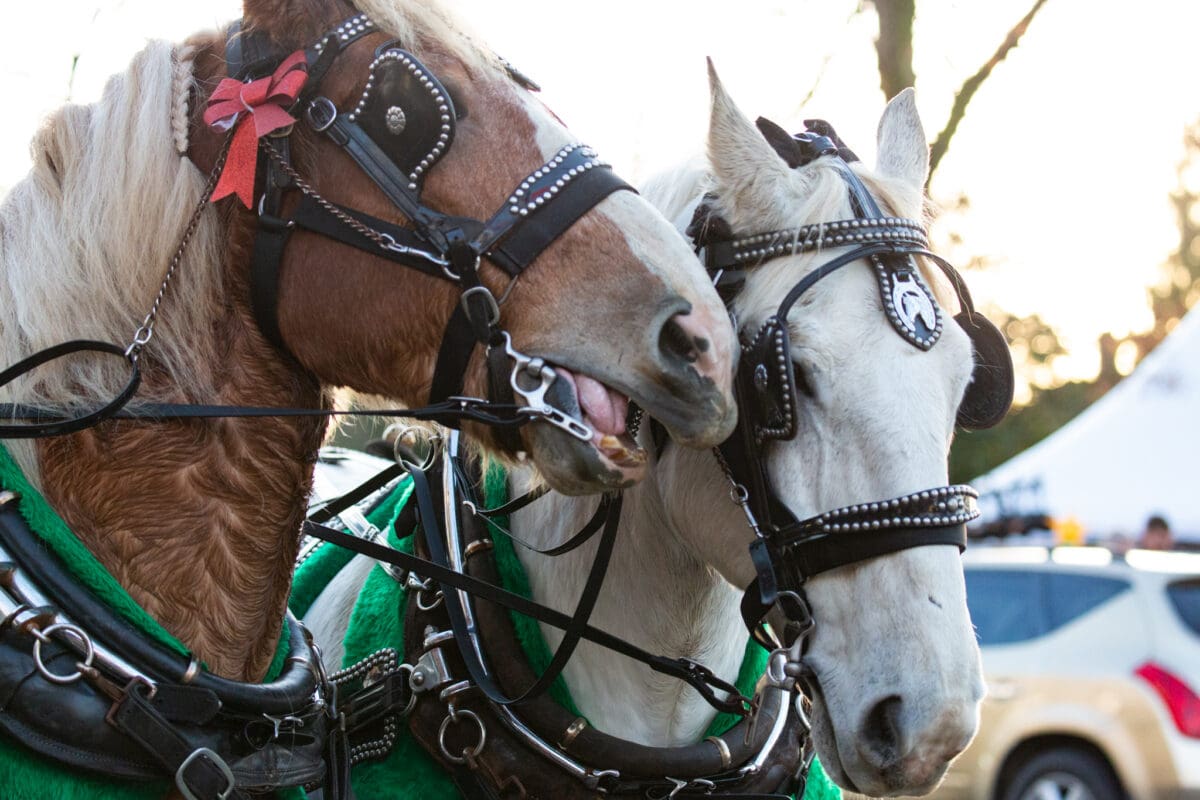
Horses pulling carriages through busy city streets face routine stress and serious risks. They work in traffic, on hard pavement, in heat, and under conditions that put enormous physical strain on their bodies.
As sensitive, social animals, they are not suited for navigating the increasingly busy, noisy, and unpredictable streets of a modern city. Horses becoming afraid and bolting also creates a safety risk for both horses and humans.
The urgency of this issue has been made painfully clear with devastating recent incidents. On Wednesday, a teenager lost his life after falling from a horse carriage in New York’s Central Park. What should have been a relaxing family vacation ended in tragedy when a horse bolted and the young man hit his head trying to help his fallen mother.
The incident renewed calls for a ban on horse carriages in New York City, with advocates pointing to back-to-back incidents this month. Last week, a horse collapsed and died near Central Park.
Previous incidents in Vancouver’s Stanley Park in 2016 and in Victoria in 2018, 2023, and 2024 have also drawn attention to the issue locally.
Vancouver still allows horse carriages on busy city streets
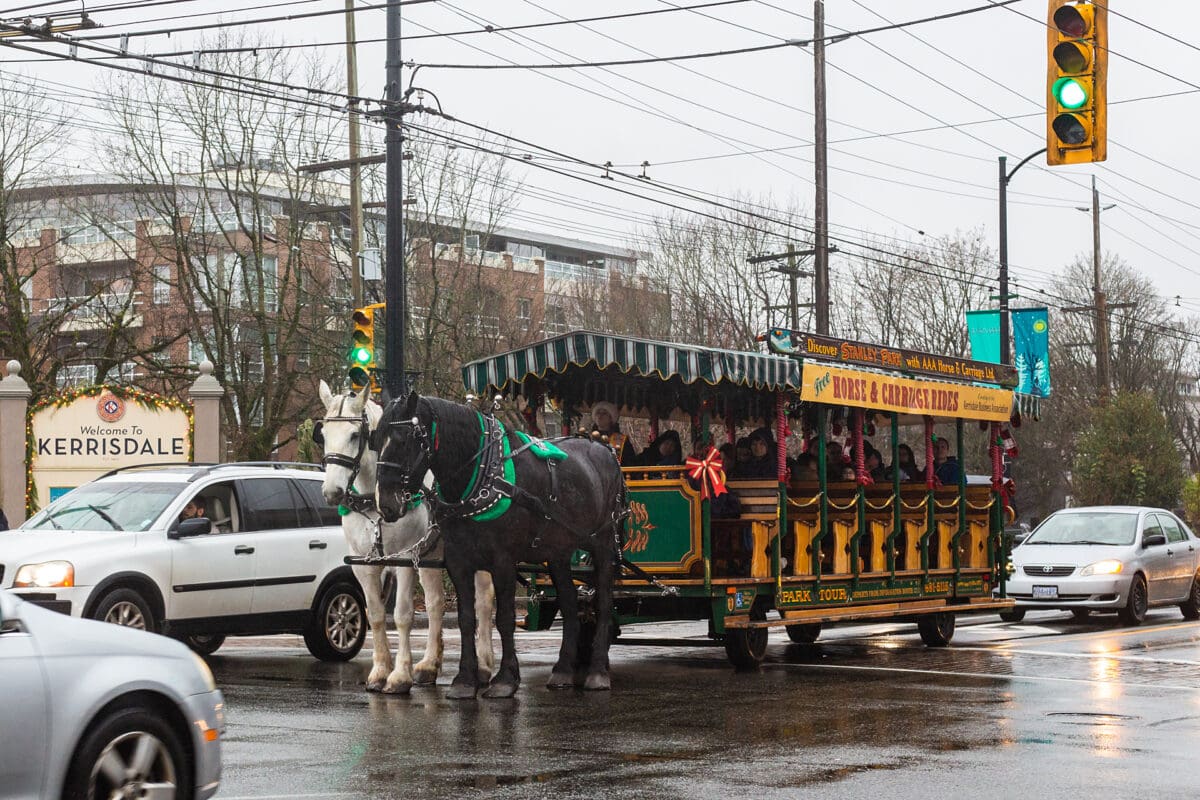
Horse-drawn carriage rides continue to operate at events in busy, high-traffic commercial districts of Vancouver, such as Kerrisdale and Commercial Drive.
Other major cities, including Chicago, Montreal, and now Philadelphia, have moved away from this practice as public understanding of horse welfare has grown.
How can you help?
If you have not yet done so, please sign the Vancouver Humane Society’s petition to support a ban on horse-drawn carriage rides on Vancouver’s busy city streets.
You can also help by encouraging friends and family to choose horse-free tourism options, or by sharing the VHS’s posts about this important issue on Facebook and Instagram.
Philadelphia’s decision is a reminder that cities can and do change when residents speak up. Vancouver can be next.
The Rideau Carleton Raceway is shutting down its horse racing program, the raceway’s operators say.
Following the closure of both B.C.’s active horse racing tracks in 2025, another racecourse in Ontario has announced an end to its horse racing program.
“The Rideau Carleton Raceway is shutting down its horse racing program, the raceway’s operators say.”
The closures come as a result of waning public support and declining revenues, which have been making the industry unsustainable at various locations. Though these horses will move to other racing venues in Ontario, the closure signals a hopeful shift in public attitudes around the use of animals in risky sporting events.
Horse racing poses serious welfare concerns due to:
Common incidents of injury and death for horses;
Issues with selective breeding—thoroughbred horses are often overbred for speed rather than skeletal strength, making their legs susceptible to fatal injury;
Young starts to horses’ short racing careers, which puts them at high risk and can cause early decline;
Aversive training methods and uncomfortable equipment, like whips and tight bits, which can cause stress and pain.
These welfare concerns put horses at risk of an uncertain future, as do the track closures that result from declining revenues and public support. As such, industry professionals should transition away from breeding new animals into an unstable future and plan for a compassionate retirement for horses who may be impacted by closures.
Close up photo of a woman hugging an older brown dog outdoors on the beach
The Vancouver Humane Society is proud to be part of a new province-wide collaborative: the Humane Societies of British Columbia. This initiative brings together seven independent humane societies to make it easier for people across BC to find trusted, local support for their animal family members, all in one place.
HumaneSocietiesBC.ca is a new resource hub that aims to help connect people to local services like veterinary assistance, pet food programs, behaviour support, and emergency care when they’re needed most.
We’ll also be joining together to share timely, life-saving information on pet health and care.
Around the world, meaningful progress is being made to end the practice of operating horse-drawn carriages on busy city streets.
In Cartagena, Colombia, where the city’s historic centre is a UNESCO World Heritage site, horse carriages are being replaced with electric ones amid growing concerns about horse welfare and safety.
In New York, the city’s new mayor has announced support for removing horse carriages from Central Park and working with stakeholders to end the practice.
Locally, the VHS’s campaign to remove horse carriages from high traffic streets in Vancouver has gathered more than 3,000 signatures and was recently featured in the Daily Hive. The campaign has been seen more than 330,000 times on social media.
TAKE ACTION: Sign the petition urging Vancouver City Council to prohibit horse carriages from busy city streets, and if you’ve already signed, please share it to help build momentum.
Below is a template message that will be sent to Mayor Sim & Vancouver City Council. Tip: personalize the subject and message for added impact, or send a message directly to: mayorandcouncil@vancouver.ca
Horse carriages & traffic don’t mix
Horses are sensitive prey animals, not suited for navigating the increasingly crowded, noisy, and unpredictable streets of a modern city. Yet, Vancouver bylaws still allow horse-drawn carriages to operate on busy roads in high-traffic commercial areas throughout the city.
These urban environments are filled with loud noises, fast-moving traffic, hard pavement, vehicle exhaust, and crowds that can easily startle horses, no matter how experienced or well-trained they are.
Previous horse carriage incidents
Below are a few previous incidents that show how quickly things can become dangerous for the horses and the public when horse carriages operate in busy urban spaces.
Victoria, 2024: A horse is spooked after an equipment malfunction, resulting in the driver losing control of the horse, who proceeds to run and buck through an intersection. Passengers jumped out of the carriage before the horse collapsed on the concrete.
Victoria, 2023: A spooked horse flees for three blocks before tripping and falling over a bike lane curb. The incident resulted in the driver being thrown from the carriage and both the driver and horse suffered minor cuts.
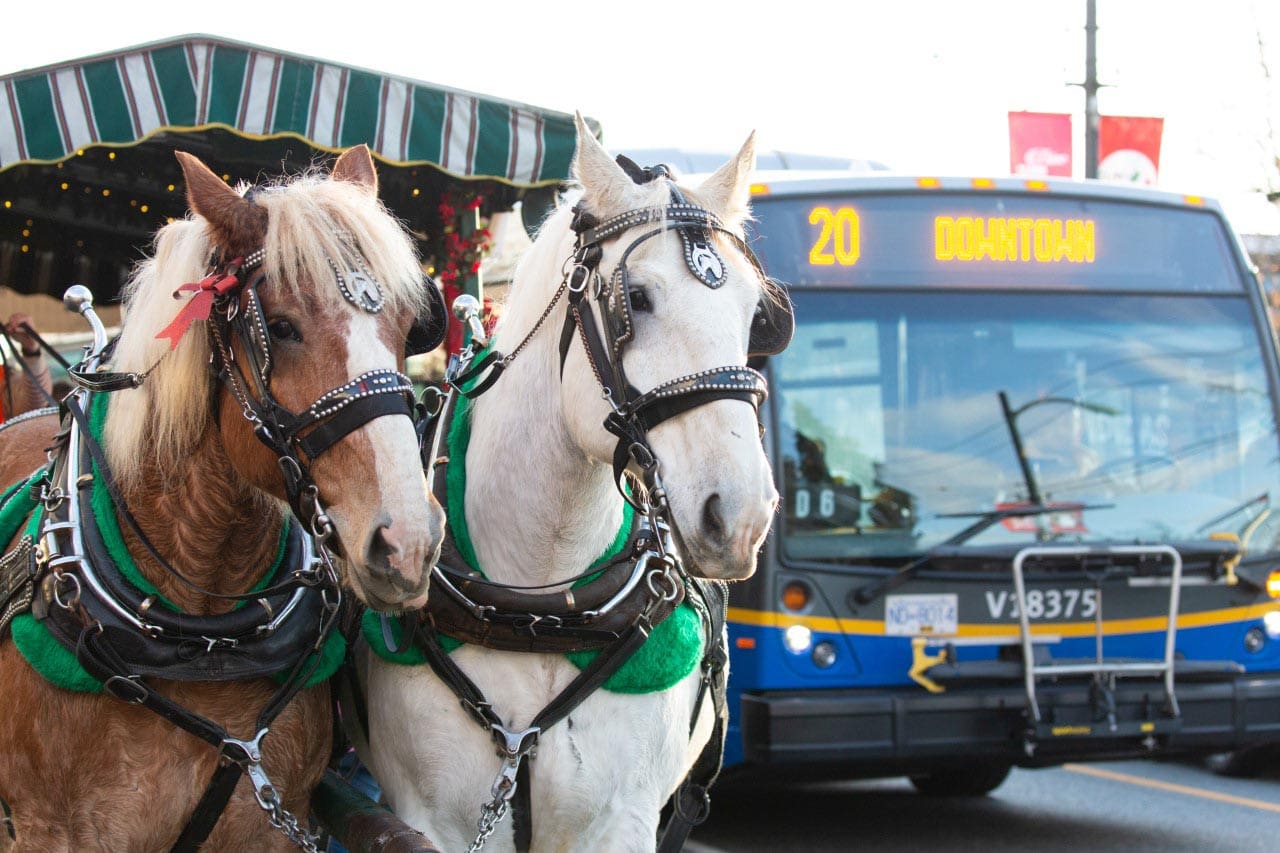
Victoria, 2018: In downtown Victoria, a horse-drawn carriage rolled back and bumped into a bus that was following too closely. The impact caused both horses to fall, blocking traffic and requiring an emergency response. The horses remained on the ground for more than five minutes, during which members of the public attempted to assist. Those assisting were not directed to stay clear of the horses’ legs, putting themselves at risk of serious injury.
Victoria, 2018: A second incident occurred only a few months later, when horses were spooked and veered off course and crashed into a parked vehicle. Witnesses reported that the horses smashed the vehicle’s windows and even climbed onto its roof with their front hooves.
Vancouver, 2016: A loud car horn startled a team of horses pulling a carriage, causing them to bolt along Stanley Park’s seawall with passengers on board. The horses left the road, crossed a bike path, and smashed a park bench with the carriage before continuing for approximately 100 metres. The driver fell from the carriage, and several frightened passengers leapt off as it sped along. Multiple people were injured, and there were concerns that the horses could have plunged over the sea wall and into the water.
Holiday event observations in Vancouver
In recent years, the VHS has documented horse carriages at holiday events in busy commercial areas, such as Kerrisdale and Commercial Drive.
The footage shows recurring welfare concerns and safety risks, including:
Horses working in close proximity to moving vehicles;
Horse carriages turning across oncoming traffic at busy intersections;
Horses exposed to loud, sudden, and unpredictable noises and movement, such as sirens, car alarms, music, dogs, and bicycles;
Members of the public approaching and interacting with horses without supervision;
Horses showing possible signs of stress or agitation, including head shaking, bit chewing, and pawing.
Sign & share the petition
Join the VHS in urging Vancouver City Council to protect the well-being and safety of horses and the public by prohibiting horse-drawn carriages from busy city streets.
Chantelle Archambault from the Vancouver Humane Society discusses the closure of Hastings Racecourse in Vancouver, which was announced this past Friday. Originally aired on The Early Edition from CBC News; shared on The Informed Animal Ally podcast.
On December 5th, Hastings Racecourse announced the immediate end of horse racing at the province’s last track.
The Vancouver Humane Society’s Chantelle Archambault sat down with Stephen Quinn from The Early Edition on CBC Radio to share the VHS’s response, previous advocacy around the racetrack, and what a compassionate retirement for horses would look like. Interview shared with permission.
Stephen: Thoroughbred horse racing at Vancouver’s Hastings Racecourse is ending after more than a century. In fact, it’s been going there for about 130 years. The operator announced on Friday it will no longer run a racing season at the historic facility.
Great Canadian Entertainment, which operates the site, described the move as an extremely difficult decision. It said the decision was made because of a lack of economic feasibility to move forward with another season of horse racing.
Now, the Vancouver Humane Society released a report earlier this year highlighting the need for public subsidies to remain operational.
And joining us now is Chantelle Archambault. She is the Communications Director of the Vancouver Humane Society. Good morning to you, Chantelle.
Chantelle: Good morning. Thank you so much for having me here.
Stephen: Thanks for being with us. Your reaction to the news on Friday that the race course is shutting down after being operational for well over a century?
Chantelle: Yeah, absolutely. I mean, on on the one hand, we’re so grateful for this step toward a future where animals aren’t bred for use risky entertainment activities like horse racing.
The Vancouver Humane Society has been advocating for an end to horse racing at Hastings for many years, given the animal welfare concerns associated with the industry.
And at the same time, we recognize that it brings quite a lot of uncertainty for those connected to the horse racing industry.
We’re very hopeful that all parties, regardless of their perspective on horse racing, share a common priority of ensuring that every horse currently involved in racing is provided with safe, secure, compassionate retirement.
That’s why we’re encouraging both the provincial government and industry stakeholders to prioritize meaningfully supporting both workers and animals in transitioning away from horse racing,
Report on Hastings Racecourse
Stephen: Your organization commissioned a report earlier this year on the history of the Vancouver Hastings Racecourse. What were some of the key findings of that report?
Chantelle: We looked at both the economic and animal welfare impacts of racing.
We found that there were decades of decline at Vancouver’s Hasting Racecourse, and the track was relying on public subsidies to remain operational.
It outlines that there was decline in attendance, revenue, race days.
The race days went down from about 150 a year in the 1980s to about 45 planned for 2025.
Attendance has collapsed from about 1.1 million people in 1982 to about 150,000 in 2022.
In 2023 and 2024, the horse racing industry received about $9 million from slot machining revenue to keep it running.
So there’s been a heavy reliance on public funds to keep this industry going.
And the report also, of course, highlighted the risks that horses face in racing. At least 14 horses died at Hastings in 2023. In 2024, the fatality rate was 1.78 deaths per 1000 starts, which is well above the industry average and nearly double the rate at tracks that have stronger safety rules.
So given that, the racing industry really no longer aligns with the City of Vancouver’s priorities for public access, sustainability, economic resilience. We were recommending an end to horse racing at Hastings Park when the current operating agreement for the racetrack expires, which would have been in 2026.
Stephen: I’m sure the people who work at the track and work with horses would say that they certainly do their best to ensure the health of horses and to make sure that they stay healthy, do they not?
Chantelle: I absolutely am sure they do. It’s impossible to work with animals and not love them and care for them.
But the reality is that there were so many deaths at this track that it seems like it’s an inevitable, inherent part of the racing industry.
What’s next for the horses?
Stephen: So what will happen then to the horses now that they’re no longer competing at the racetrack?
Chantelle: It’s a great question. A responsible transition plan really means developing clear, transparent retirement pathways for every horce that’s racing.
Horses are only able to race for a fraction of their natural lifespan, so this should be a baked in part of the industry, and we are hopeful that it is. Under normal circumstances, any industry that relies on animals should already have a well-developed safety net and in place for animals who age out of the industry.
From our perspective, a good outcome would be for the horses to move out of the racing industry into an environment where they can have positive experiences, bonds, and the freedom to express their natural behaviors.
So some examples of that would be retiring to a sanctuary or therapy horses, in a setting where they can regularly have time to run free.
Declining public support
Stephen: Chantelle, is this something you see just happening here in the Lower Mainland or in British Columbia, or are we seeing a decline in in horse racing operations across North America?
Chantelle: We really only have been looking very closely at British Columbia, but I have heard whisperings that there there is a wider decline across the industry as a whole.
There’s decreasing public support for this industry. I think it’s clear that people are seeing across multiple industries that use animals and put them at risk like this, that there is a decline in public support as people learn more about animal welfare and animal sentience and learn that animals are beings who can feel pain, feel fear, feel stress, and care about their lives.
Stephen: Chantelle, we’ll leave it there this morning. Thank you so much for taking the time. We appreciate it.
Chantelle: Thank you so much for having me.
Stephen: That is Chantelle Archambault, who is the Communications Director at the Vancouver Humane Society, talking about the end of horse racing at Hastings Park after 130 years, and what will happen to the horses and all of the people who work with those horses as well.
The Vancouver Humane Society (VHS) has learned that Vancouver’s Hastings Racecourse is ending horse racing effective immediately. This announcement follows recent government funding changes, including an end to casino slot machine revenue being provided to the horse racing industry, and declining attendance, shrinking revenues, and increasing animal welfare concerns in recent years.
A VHS-commissioned report released earlier this year highlighted decades of decline at Vancouver’s Hastings Racecourse and its dependence on public subsidies to remain operational. The report also raised concerns about the welfare of horses used in racing. Recent data illustrates the serious risks horses face. At Vancouver’s Hastings Racecourse, at least 14 horses have died since 2023. According to the B.C. Gaming & Policy Enforcement Branch, the 2024 fatality rate at Hastings reached 1.78 deaths per 1,000 starts, which is markedly higher than the North American industry average of 1.11 and nearly double the rate at tracks operating under stronger safety regulations (0.90).
This announcement marks a milestone toward a future in which animals are not bred, used, and put at risk for entertainment. At the same time, the VHS recognizes the uncertainty the decision creates for the people and animals currently connected to B.C.’s horse racing industry.
While perspectives on horse racing vary, we hope all parties share a common priority: ensuring that every horse currently involved in racing is provided with a safe, secure, and compassionate retirement. We encourage the provincial government and industry stakeholders to provide support for both workers and animals alike in transitioning away from the horse racing industry.
As of January 31, 2026, the B.C. Government will no longer provide casino slot machine revenue to the horse racing industry.
This marks a meaningful step toward phasing out an industry that has long depended on government funding, despite declining public interest, shrinking revenues, and ongoing concerns about the welfare of horses used in racing.
The VHS welcomes this progress while acknowledging the uncertainty for those currently involved in the horse racing industry.
Government and industry are urged to prioritize a safe, compassionate retirement for all horses and to support both workers and animals through the industry’s transition.
The cut signals what may be another nail in the coffin for B.C’s last horse track.
“Even with continued government investment from casino-generated revenue, the industry is not sustainable due to declining revenues, public participation and attendance, a letter from the province reads.”
“Government officials said the amount of slot machine income that went to the horse racing industry was about $8 to $10 million annually.”
What will happen to the horse racing industry?
While media reports state that it is unknown whether the 2026 horse racing season will go forward, statements from industry stakeholders and the B.C. government observe that declining revenues and public attendance make horse racing unsustainable in the province.
A recent VHS report outlines the high racing-related fatality rate, including at least 14 horse deaths since 2023, and the long-term decline in attendance and revenue at Vancouver’s Hastings Racecourse. The report recommends that the City of Vancouver end horse racing at Vancouver’s Hastings Park when the current Operating Agreement expires in 2026.
Slot machine revenue for Hastings Racecourse will be pulled just months before the racetrack’s lease ends with the City of Vancouver in 2026.
More than 1,500 advocates have already signed a petition calling for the lease to not be renewed, supporting an end to horse racing at B.C.’s last racetrack.
Why has the VHS been raising awareness about horse racing?
Deaths at Vancouver racecourse
Hastings Racecourse has seen a concerning pattern of horse deaths, including eight in 2023, four in 2024, and at least two between April and June 2025. In 2024, the rate of horse deaths at Hastings was 1.78 per 1,000 starts—much higher than the industry average of 1.11 and nearly double that of tracks under stricter safety rules (0.90).
Early start, lifelong harm
Most horses start training and/or racing at just 2 years old, before their bones are fully developed. This puts them at high risk for serious injuries and early decline. Thoroughbred horses are often overbred for speed rather than skeletal strength, making their legs susceptible to fatal injury.
Painful & stressful practices
Horses often endure harsh training methods and uncomfortable equipment, like whips and tight mouth bits, that can cause stress and pain.
A recent report from Vancouver park board staff includes a consideration for removing “animal-powered transportation” from Stanley Park.
For years, the VHS has called for the removal of horse-drawn carriages from the park.
The use of carriages in crowded urban environments poses a risk to horses and the public. Horses endure regular exposure to traffic, noise and pollution; long hours of standing and walking on hard surfaces; and hard labour under sometimes extreme weather conditions.
Other jurisdictions, such as the City of Montreal, have banned horse-drawn carriages due to animal welfare concerns and incidents.
Read media coverage on the report and the VHS’s campaign below. Stay tuned for updates!
Park board staff are giving commissioners dozens of options to manage traffic in the park
“Vancouver park board commissioners will be asked to weigh up dozens of possible options to reduce the number of cars entering Stanley Park each year.”
“The document includes an option for removing ‘animal-powered transportation’ in the park.”
“The Vancouver Humane Society has a campaign to have the Stanley Park Horse-Drawn Tours business removed from the park.”
“‘Being surrounded by motor vehicle traffic forces horses to inhale toxic exhaust and causes them mental distress, which can make the animals unpredictable and potentially dangerous to park pedestrians, cyclists and motor vehicles,’ the society states.”
Screenshot: Incident on October 19, 2023 from ElementsCasinoSurrey.com
Last week, Surrey’s Fraser Downs Racetrack announced its immediate closure.
The move follows a wider trend of waning public support for horse racing, plummeting revenues, and increased knowledge around animal sentience and well-being.
The Vancouver Humane Society (VHS) welcomed the decision by the City of Survey to terminate the racecourse’s lease, and called for the City of Vancouver to follow suit with Hastings Racecourse.
A recent VHS report shared with the City of Vancouver in June outlines persistent animal welfare concerns and the long-term decline in attendance, revenue, and race days at Vancouver’s Hastings racecourse. The report recommends ending horse racing at Hastings Parks when the current Operating Agreement expires in 2026.
The Fraser Downs Racetrack announced there would be no more horse racing “effective immediately” after the City of Surrey, which owns the land, decided to terminate its lease.
“The Fraser Downs Racetrack announced there would be no more horse racing ‘effective immediately’ after the City of Surrey, which owns the land, decided to terminate its lease.”
“The Cloverdale Fairgrounds track is one of two in B.C. and the only one that hosts standardbred harness racing.”
A groom at the Fraser Downs racetrack said the abrupt announcement of the harness racing track’s closure last week is a blow to her childhood memories.
“The Vancouver Humane Society welcoming the city’s decision, calling horse racing ‘outdated’ and ‘harmful’ entertainment.”
“‘While the closure at Fraser Downs marks an end to racing at that site, it is emblematic of a wider, long-overdue shift away from horse racing,’ the society’s campaign director, Emily Pickett, said in a statement.”
“‘Horse racing inherently subjects horses to pressure and danger, debilitating injuries, early physical decline, and at times fatal outcomes.'”
Screenshot: THE CANADIAN PRESS/Jeff McIntosh via CTV News
With the 2025 Calgary Stampede almost a week away, organizers are carefully curating a narrative on improved animal welfare at their controversial and deadly rodeo and chuckwagon races.
While minor changes like shaded areas and heart monitors are being promoted as signs of progress, they do little to address the serious, ongoing risks animals face in these events.
At least 109 animals have died at the Stampede’s animal events since 1986.
The VHS continues to call for a shift away from rodeo and chuckwagon racing.
Read media coverage of the new rules below, share your concerns in the comments, and join VHS in calling for an end to inhumane rodeo events at the Calgary Stampede.
Tents are being set up to provide shade for bulls and broncs and some chuckwagon horses are to be fitted with tiny electrocardiograms at the upcoming Calgary Stampede.
“The 10-day celebration of western culture, which runs from July 4-13, has long been a target of animal rights groups. The Vancouver Humane Society wants the rodeo portion of the Stampede eliminated.”
“‘We’re seeing deaths at the Calgary Stampede almost every single year. It’s really not a matter of if another animal will die at the Stampede … it’s when,’ said Chantelle Archambault with the group.”
Calgary Stampede officials spoke about animal care on Tuesday and a continued partnership with UCalgary to address the ongoing safety.
“The Vancouver Humane Society says 109 animals have died at the Calgary Stampede since they started keeping track of fatalities in 1986.”
VHS Communications Director Chantelle Archambault shared, “I would really question what is entertaining about seeing animals suffer… These animals are not only facing fear and stress inherently in these events, but a risk to their lives.”
“Last year it did turn out to be the deadliest event since 2019.”