- At the 2026 Calgary Stampede, rodeo and chuckwagon events continued to put animals at risk of fear, stress, injury and death, while also exposing human competitors and workers to serious safety risks.
- The 10-day event saw two chuckwagons collide resulting in a serious injury for one of the horses, as well as harsh handling of a bucking horse in a chute leading to a cruelty complaint.
- With support from the Vancouver Humane Society, Calgary Animal Rights Effort advocates distributed educational materials to Stampede attendees at four peaceful rallies.
TAKE ACTION: keep the momentum going by signing the #SayNoToRodeo pledge, using the quick-action tool below to contact government decision-makers and, if your workplace attends the Stampede, use the template letter to ask your workplace to choose cruelty-free activities for any future Stampede gatherings.
Share this post!
Table of contents
Another Calgary Stampede has come to a close
The crowds are leaving and the temporary attractions are coming down, but the concerns surrounding animals used in the events remain unresolved.
From July 3 to 12, animals were once again put at risk of stress, injury and death in fast-paced rodeo and chuckwagon events for entertainment. Calves were chased, thrown to the ground and tied. Steers were pursued and wrestled by the neck. Horses and bulls were made to buck. Teams of horses pulled wagons at high speeds around tight turns and alongside other teams.
These events depend on animals reacting to pressure, fear, discomfort and stress. The behaviours presented as entertainment to the onlookers in the crowd, including fleeing, bucking, resisting and struggling, can be signs that an animal is overwhelmed or trying to escape what is happening.
Reported incidents at the 2026 Stampede
Two high-profile incidents received media attention, including a horse suffering a serious injury after two chuckwagons collided at the start of a race on July 11. One horse was eventually able to walk from the track, while the other remained down and was lifted into a trailer behind a privacy tarp. The injured horse is reportedly undergoing evaluation.
Footage from a bucking event earlier in the week also raised concern and resulted in a cruelty complaint, after a handler was seen forcefully pulling on the mane of a horse who was down in the bucking chute. The handler also repeatedly smacked the horse in the head. No further enforcement action was taken by local authorities.
Some rodeo injuries may not be immediately visible. The full impact of a fall, collision or other incident may only become apparent after an animal leaves the arena, but those injuries and deaths are not publicly available
Animal welfare cannot be measured only by whether an animal survives an event. It must also consider what the animal experienced before, during and after being used in an event.
A long record of animal deaths and injuries
At least 110 animals have died in the Stampede’s rodeo and chuckwagon events since the VHS began tracking fatalities in 1986. That represents an average of one animal death every 3.6 days of competition. Most of the recorded deaths have occurred during the chuckwagon races.
In 2024, three chuckwagon horses suffered fatal injuries and a steer’s neck was broken during a wrestling event. In 2025, a horse named Rider was euthanized after suffering a catastrophic leg injury during a chuckwagon race.
Rodeo events also put people at risk
The risk of injury or death extends to human competitors and handlers as well. Each year, rodeo participants experience injuries of varying severity, with multiple reported deaths directly linked to rodeo activities since 1996.
Research has found that ‘rough stock’ events, such as bull riding and bronc riding, carry particularly high injury risks with contusions, sprains, and concussions being the most frequent injury types. While human competitors can choose to participate, and animal participants cannot, the risks to both are serious and should not be minimized.
Competitors and their families can experience serious physical, emotional, and financial hardship when injuries occur. Recognizing these impacts is an important step towards a future where the welfare of both people and animals is prioritized under a One Welfare framework.
A safer future should protect both people and animals by moving away from activities that include fear, force, and predictable injury risks. By working together to promote practices that reduce harm, we can help create a rodeo culture where both human and animal well-being is protected.
Recent efforts to hide the reality behind the rodeo arena
In recent years, Calgary Stampede organizers and allies have ramped up messaging about their so-called commitment to animal welfare, all while making it increasingly difficult for the public to learn the reality of what happens to animals used in rodeo.
Last year, major advertising companies rejected or pulled ads set to run in Calgary that would have pointed out the welfare concerns around rodeo. The VHS and Animal Justice raised concerns about mounting censorship and the decision by private advertisers to keep animal welfare messaging from the public.
Online advertising groups like Meta regularly reject promoted videos and photos of unaltered rodeo events displaying animal welfare messaging, claiming these images are too violent to be shared, despite permitting similar photos being used to promote Stampede events on the same platform.
In May, Alberta’s Animal Protection Act was updated to better protect animals such as pets, but added a specific exemption which would allow animals to be in distress during rodeo and racing events, so long as the treatment is considered reasonable and generally accepted. This change makes it more difficult to protect animals used in these controversial sports.
We Animals Media, an animal photojournalism organization applied for a media pass at the Calgary Stampede this year to document the rodeo and chuckwagon races. Despite following up, the Stampede never responded to their application. Media accreditation is required in order to bring professional photography equipment to the Stampede grounds, and public recording of the rodeo and chuckwagon races is not permitted.
We Animals Media shared that “If the Stampede is proud of how it treats animals, it shouldn’t be afraid of a camera.”
Live broadcast coverage of the rodeo and chuckwagon races also raises transparency concerns. The camera routinely cuts away during moments that would be difficult for viewers to watch, such as calves hitting the end of the rope, rough handling of animals in the chutes, or horses being injured during chuckwagon races. This pattern played out again this year: at least two chuckwagon races were cut from broadcast coverage, and no mention was made at the time that a horse had suffered a serious injury during one of them.
Because of the combined efforts of Stampede organizers, the Alberta government, and private businesses, the animal welfare concerns around the rodeo and chuckwagons are largely hidden from the public, who are instead provided with a carefully selected, sanitized, Stampede-approved version of events.
Supporting animal advocates
To combat efforts to silence animal welfare messaging, the VHS has been working with advocates in Calgary and organizations across the country to increase awareness about animal suffering at the Stampede rodeo and chuckwagon races.
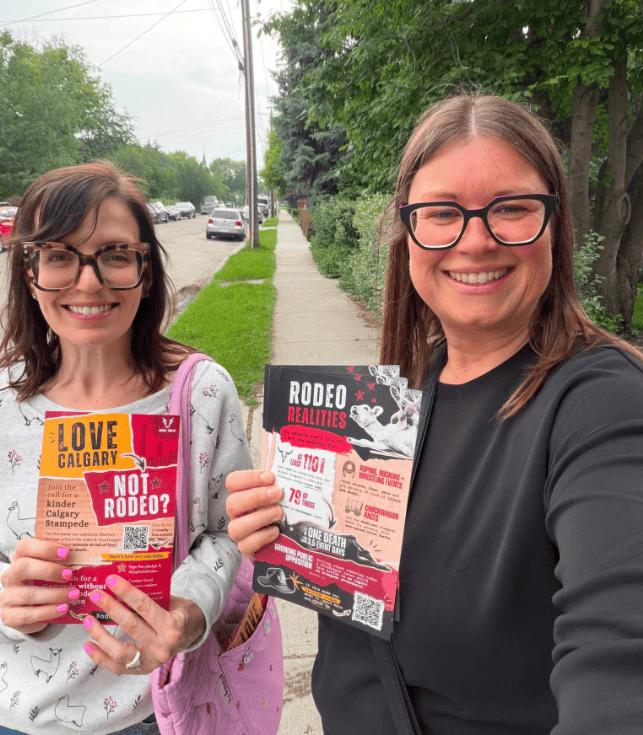
Throughout the Stampede, Calgary-based advocates worked to keep animal welfare visible. With resources and support from the VHS, Calgary Animal Rights Effort advocates held peaceful Buck the Rodeo rallies on July 4, 5, 11 and 12 near the Stampede grounds.
Advocates spoke with members of the public, handed out educational materials and encouraged visitors to consider what animals experience behind the spectacle.
They also promoted cruelty-free ways to take part in Stampede season, including community events, food, music, arts and other activities that do not depend on animals being frightened or put at risk.
The campaign continues after the Stampede
The end of the 2026 Stampede does not need to mean the end of public attention.
Decisions about funding, sponsorship, workplace outings and future programming are made throughout the year. This is when respectful and consistent public engagement can have the greatest influence.
You can continue supporting change by:
Did your workplace attend the rodeo or chuckwagon races?
Workplace outings should be activities where employees feel comfortable, respected and able to participate.
For some employees, attending a rodeo conflicts with deeply held concerns about animal welfare. Others may be uncomfortable watching events where animals or human competitors could be seriously injured.
The VHS has created a template letter that employees can share with their employer to respectfully ask that future team activities are inclusive and do not involve rodeo or other animal events.
Starting the conversation now can help your workplace make a different choice in 2027.
It’s time for a Stampede that leaves animal suffering behind
The Calgary Stampede has evolved throughout its history. It can continue to change.
Ending the rodeo and chuckwagon races would not mean ending Calgary’s celebration. It would mean creating a celebration where community, culture and entertainment no longer come at the expense of animals.
Another Stampede has ended. The work to build something kinder continues.